Pages

Showing posts with label marketing news. Show all posts

The Best Approach to Email Marketing


A new survey finds that marketing messages received via email are the most likely to make us shop. (Exact Target via Business Insider).


This internet cafe helps your marketing messages get out there.
Email. From Flickr user Matt Wi1s0n.
In fact, the Exact Target data tells us something really interesting. While many blogs and news outlets have trumpeted the death of email, this is largely for personal communications. That's right - if I want to talk to my college roommate, I'm reaching out to her on Facebook, not email, and if I want to say hi to my husband during the workday, it's best to send him a text.

BUT.... EMAIL IS CONSUMERS' PREFERRED DIRECT MARKETING CHANNEL.

Sorry for the shouty caps, but this is really important. Consumers want to receive marketing messages on email, where they can easily save them for when it's convenient, and email goes where they do - on their mobile devices, tablets, laptops, and desktops. 77% of consumers in the survey said they preferred their permission-based marketing to come through email.

At the same time, marketers are picking up this message and online consumers have received 21% more email marketing messages in the first quarter of 2012, compared with the same time last year. (Responsys via Internet Retailer)

What's your takeaway here?

Let's talk for a minute about how you can make email marketing work for you. What's the best way to approach email marketing now that your customers are so distracted by games, Twitter, and Facebook?

If you've been ignoring your own email list, it's time to get it out and dust it off again. After all, the people on your email list have either purchased your products at some point, or otherwise opted in to get your messages. These are people who already like your brand.

So put yourself in their shoes for a minute. If you were getting email from a retailer you liked, what would you want to see?

  1. Free shipping. This is the #1 strategy and has been for a while now. If you can make this work financially, do it. You can try it for a limited time, for purchases over a certain amount - whatever doesn't kill your profits.
  2. What's New? People will get bored if you send them messages about the same thing every week. Change it up - tell them about your new items, new trends, and new uses for your products. How does your product make your customers' lives easier?
  3. Be timely. What's going on right now? April is Earth Day and I've already seen some green messaging in my email inbox. Look at holidays - both those in the mainstream, like Easter and Passover, and the more quirky, like No Housework Day (it was on April 7), or Dance Like a Chicken Day (May 14).

Can your business adopt one of these crazy holidays and do a social campaign around it? You could gain a lot of new fans by asking folks to send videos of themselves dancing like chickens. Post the best ones to your Facebook page, and then let fans vote for the winners, who get a prize. Fight Procrastination Day isn't until September 6 this year, so think about this now instead of later.

How can you solve common problems with your email marketing?

  1. Bad addresses? Ask your customers to update you every time they buy. If people can set up accounts on your web site, send a request for account updates at least once a year.
  2. Low open rates? Work on your headlines, even test two against each other to a small portion of your list, and deploy the winner to your entire group. Also, look at your email results over the past year and see which messages had the best open rates. Try a similar approach and see how that works for you.
  3. Low click through rates? Writing the world's best headline won't help you any if the message and the headline don't seem congruent. The message should be in a brand and tone that matches your headline. Make sure the call to action is clear, and that there are multiple opportunities for customers to click. Ask for the sale. Use engaging visuals.
  4. Low action rates? What happens to customers once they click through. Do they get to a page with the content they expected, or do you dump them on your home page without any guidance? Consider investing the time to develop a special landing page for your emails, which helps customers understand what to do next.
  5. Small list? Since we know now that consumers are most likely to want marketing messages on email, consider directing advertising and social efforts towards getting them to sign up. Also, make email sign up prominent on your home page, and part of your checkout process.

Questions, comments, concerns? I'd love to hear your thoughts and experiences on email marketing. Please share in the comments or drop me a line.

News this Week: Dilbert, Congress, and K-Mart Angels

What should you be paying attention to this week? 

Angel. Flickr user Ewan Traveler.
From blogger Sarah Gallagher at Gears and Shifts, some words on employee morale and office culture based on the wisdom of Dilbert.

Your takeaway: It's time to look in the mirror. Are you allowing, fostering, or participating in anything that contributes to poor treatment or poor morale for employees? Are you using resources to benefit the company, or your own convenience? Are you rewarding identical behavior in some people, but not others? Make 2012 the year you treat your employees better and provide opportunities for them to grow. If you've got a bad boss, make 2012 the year you stop responding to bullying and other poor treatment and/or embrace a new opportunity.

As I'm writing this, Congress has finally approved a two-month extension on the payroll tax cut.

Your takeaway: I wrote about this possibility back in August -  and how it might make 2012 a more difficult year for pretty much everybody. The Obama administration helped things along with a Twitter campaign using the hashtag #40Dollars - asking Americans to tell Republicans what it would mean to us to lose $40 out of each two-week paycheck. You can find out more about the campaign and what $40 means to some people from this infographic, released by The White House. Let's hope Congress does the right thing and extends the payroll tax cut all the way through 2012.

Finally, in even better news, Secret Santas all over the country are paying off layaway accounts for strapped K-Mart shoppers, and a new study finds that Americans are, on average, more generous that people from any other country, with three out of five giving to charity and two out of five doing volunteer work this year, despite the poor economy. (Syracuse.com and ABC News)

Your takeaway? Who can you help between now and the end of the year? Take some cookies to a friend (or make a new one), walk the dog for an elderly neighbor, or make an extra gift to charity. The world will only get better if we make it that way.

Happy Holidays and thanks for reading!

News this Week: Kindle Fire, Holiday Sales, Online Tracking

What should you be paying attention to this week?

Three new tools to help you track everything you do online - if you're terrible at keeping track of all that great content you see in your daily journeys through Twitter, Facebook and elsewhere, EgoArchive, Memolane, and Greplin can help.

Your takeaway: I don't know about you, but I'm a little squeamish about archiving my entire online life online. At the same time, I am always losing cool links. These might be worth considering if you're starting a blog or wanting to raise your social media presence, but can't keep your content organized. 
Holiday retail sales continue to be a bright spot, says the National Retail Federation, which just raised this year's sales forecast to $469.1 billion. (New York Times)


Your takeaway:
Here are four ways to stay relevant after Cyber Monday, including Free Shipping Day, which is December 16th. On the other side of the coin, if sales are doing so well, what's with so many empty shopping malls? This economy isn't all better yet.

The new Kindle Fire already has software update on the way, due to several major complaints, including an unresponsive touch screen, slow browsing, and lack of privacy. (Washington Post)

Your takeaway: You can never do too much product testing. Make sure you're including people who are familiar and totally new to the product. Sometimes it's a good thing to slow your roll and get it right, rather than invite poor product reviews and disgruntled customers.
What's up with you this week? Drop me a line and let me know.
Have a good weekend, and thanks for reading.

News this Week: Yelp, Google, Cyber Monday

What should you be paying attention to this week?

Yelp users in Corvallis, OR have their own logo.
First, online review site Yelp has filed for an IPO in hopes of raising about $100 million. Yelp generates income from local advertising, and though it made $58.4 million from January - September of this year, it still isn't profitable. (Mashable)

What's Next: Watch for news from analysts who are looking at the volatile and competitive marketplace, and where Yelp fits in with brands like Groupon, LivingSocial, and Angie's List. Will be interesting to see where this one goes.

Google Checkout is over, replaced by Google Wallet. Wallet's ease of use means that consumers are adopting it at a far faster rate than they ever used Google Checkout. (Search Engine Land)


Your takeaway: It's always a good idea to make sure that consumers can buy from you using as many options as possible. You don't want to miss sales because you're not available.

Cyber Monday is the biggest online shopping day of the year, and it's 10 days away. If you're not 100% solid on what you're doing to drive customers to your brand, here's a procrastinators guide to Cyber Monday.

Don't mess this up: If you think you can sit this one out, don't. Last year, consumers spent more than $1 billion on the Monday after Thanksgiving.

Need help with holiday strategy and business planning? Let me know. 

Have a great weekend, and thanks for reading.

News This Week: Smartphone Use, Google+ and You

What should you be paying attention to this week?

His Holiness the XIV Dalai Lama. Photo: Flickr user Abhikrama.


First, for all of us thinking about mobile, it's important to remember that only 37.4% of US mobile users have a smartphone. (This blog, and Business Insider)

Your takeaway: This is good to consider as you invest in mobile apps and marketing. A simple text messaging campaign has the potential to do far more than an expensive app, depending on who is in your core audience.

Second, Google+ has opened up company pages. These look the same as people pages, but there's a little icon to indicate that they are branded pages. More on this from Mashable, including instructions on making your own company page.

Your takeaway: This is going to make Google+ a true competitor and possible game changer in the social world - now business can really be done on Google+. I'd recommend that you try to spend a few minutes with Google+ sometime in the next few weeks to determine if you need a presence and how much time it might take to maintain it. By some reports, most people on Google+ are either involved in the tech or social media world, but when brands like Coke and Target start doing promotions on there, more people will follow. Also, content like the Dalai Lama - Desmond Tutu birthday hangout will bring more people to Google+ to see what's possible.

Have a great weekend, and thanks for reading!

The Facts About Mobile Marketing

I've been talking a lot about mobile marketing on this blog lately - ruminating about the wisdom behind investing in mobile apps, thinking about how customers use their mobile phones while they engage with your brand, and reporting on current mobile news.

That's all fine and good, but it's important to take all of this with a grain of salt.

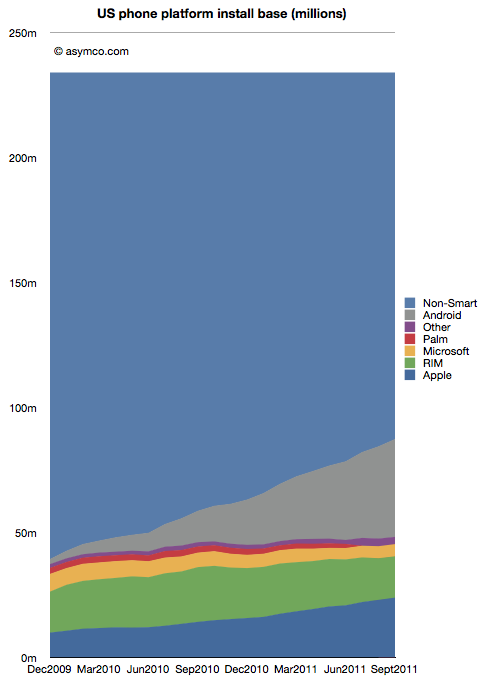
Chart from Business Insider/Asymco.
Why? Check out this chart, from the folks at Business Insider and Asymco. I'm reposting it here, because it's really, really important. 

What stands out? While the US still has the largest smartphone market (China is catching up), only 37.4% of mobile phone users have a smartphone. Android is the most common, with 39 million users. Apple smartphones have about 24 million users.

So, what does that mean? 


Although smartphone adoption is continuing to rise, the vast majority - 62.6% - are not on a smartphone. That means many of your customers can't use all those fancy apps - they can't use your special app, they can't find you on Yelp or RedLaser or anything else, they can't download coupons or reviews or anything else.

So, how do you reach them?

This is why you have multiple channels - you'll need to keep paying attention to your web site, support a robust email program, and (gasp!) answer the phone to make sure you're reaching everyone, unless all of your customers are urban, high-income people between the ages of 25 and 39. And don't forget good, old fashioned text messaging. One of my favorite local bars handles free dessert coupons via text - that's right - no fancy app, no downloads- just a text and a free dessert.

Need help reaching a diverse customer population? Let me know - I can help.

News This Week: Women, Siri, Real Time

What should you be paying attention to this week?

The world's women are now responsible for more of the world's economy than men, controlling $20 trillion in yearly consumer spending in 2009, a figure that will continue to rise in the next five years. (Harvard Business Review)

Your takeaway: Don't ignore your female customers, but don't patronize them either. It's not about "making it pink" - women don't  need pink web sites or pink merchandise to embrace your brand. We need quality products, easy access to reviews and other product data, and a way to talk to our friends about it.

To the women's only train cars in India. Photo: Flickr user Zoonabar.

The iPhone 4S's new digital assistant, Siri, is down. According to this article, Apple was unable to be reached for comment. (Business Insider)

Your takeaway: Bugs happen, seemingly no  matter how much you test. Don't ignore them and get them resolved as quickly as you can. Communicate progress via all possible channels and make it right. Customers become more loyal when you prove that you stand behind what you do.

Google Analytics Real Time tells you what's happening on your site right now, and is now available to people with the new version of the Analytics software. (Google)

Your takeaway: Real Time can be really useful to determine the immediate impact of social media posts - on your blog, Facebook, Twitter, or on other networks. Even more useful, you'll be able to see when  your social media stops working - how long does a Facebook post last, or a Tweet?


Have a good weekend, and thanks for reading!

News This Week: Shopping Habits of Frugalistas, Curated Content

Early online shopping. Flickr user Garethjmsaunders.
What should you be paying attention to this week?


39% of Americans
have already started their holiday shopping, and some frugalistas are already done. Retailers discounted aggressively in October, and without any one toy or tech gadget rising to the top as this year's must have, there's no reason for shoppers to wait.

Your Takeaway: How are you helping holiday shoppers plan their shopping and get great deals? Help them get organized with gift lists and gift ideas by type of recipient. Click here more posts from this blog about holiday planning.

Macy's, Target and other major retailers now using editorial and curated content to drive sales. Macy's and Target both launched online magazine-type sites that include trending news, fashion guides, and user-generated content to help guide shoppers to the right looks.

Your Takeaway: You're probably not in a position to create something on the magnitude of what Macy's and Target are doing, but that doesn't mean you can't give your customers a little more guidance. Consider putting together outfits or other sets of product that go together, linking relevant posts from your blog to your product, and bringing up the prominence of customer generated content on your site. This doesn't just mean customer reviews - get customers to send you pics and videos of them using your products, and you may gain some marketing gold.

Consumers shop in stores but buy online, finds a new survey by electronics site Retrevo.com. The most typical behavior is for today's frugalista customers to find something in your store that they like, and then use their smartphones to compare other retailer's pricing and availability to yours.

Your takeaway: How will you measure up when customers do this? People don't always buy the least expensive thing, but you'll need to be competitive, on service and quality as well as price. Also, now is a good time to make sure your site is optimized for mobile and you're available on check-in sites like FourSquare. After all, people will be in your competitors' stores checking your prices, too.

Have a great weekend, and thanks for reading.

News This Week: Postal Rates, Facebook Posts, Ads and Economy

What should you be paying attention to this week?

Mailbox. From Flickr user Pocius.
The United States Postal Service has announced a postal rate increase, effective January 22, 2012. The average increase is 2.1% - it will be more for some types of mail and less for others. (Multichannel Merchant)

Your takeaway: If direct mail is part of your strategy, your marketing just got more expensive. If you ship products to your customers via USPS, that just got more expensive too. Crunch the numbers carefully to figure out what this might cost you, and look for creative ways to save - there are lower increases on certain sizes of mail, and you might evaluate different carriers for your customer shipments and see if you can lock in some lower pricing now.


The average lifetime of a Facebook post is 22 hours and 51 minutes for comments and likes, according to researcher Jeff Widman of PageLever. See more information on his study at Entrepreneur.

Your takeaway: You need to post on Facebook daily or you run the risk of being forgotten. If this sounds overwhelming, tools like Hootsuite help you schedule posts ahead of time so you don't forget. I like to do a social calendar on a weekly basis - for my clients, I sit down each Friday and plan out the posts for the following week, mapping them to inventory needs and what else is going on in the marketing calendar at large. If things change, I can always reschedule or change posts as needed.

Advertisers trying to connect with consumers are referencing the poor economy more often in their messaging these days - a tactic they dropped when the economy started to improve a bit last year. This is a risk, as consumers don't want to be reminded of bad news, but do connect to ads referencing bail-outs and Wall Street fat cats. (Marketplace)

Your takeaway: A great deal always resonates, whether you reference current events or not. Connect with customers with a great deal, attentive service, and quality products. Be prepared to be nimble - the changing landscape out there means that an ad that takes six months to produce might be outdated by the time it's ready if it's based on this week's news.

Thanks for reading, and have a great weekend!

News this week: Places Facebook isn't used, Online Shopping, Blackberry Outage

What should you be paying attention to this week?

Blackberry. Flickr user Arrayexception.
In more bad news for Blackberry maker Research In Motion, which is really taking a hit from the more popular iPhone and Droid devices, a huge Blackberry outage spread this week from Europe, the Middle East, Africa, and South America on to parts of the US and Canada - seems to be stemming from a switch problem. (Mashable)

Your takeaway: No matter what kind of device you use most, think about what you'll do if it's not working. I always stay a few tweets and Facebook posts ahead using tools like HootSuite, just in case. My email and contacts are backed up in a couple of different ways, and so are my other files.

Artist Ian Wotjowicz has used maps from NASA to generate a picture of where Facebook has the most users, and which places it hasn't penetrated. Still available for Faceover are places in Asia and North Africa. (Business Insider)

Your takeaway: You probably don't need to take over the world to grow your business, but it's a good idea to regularly investigate your geographic reach and see where it would be logical to grow next. It can be especially useful to map your customers by zip code to see if there are areas that could use a little advertising love.

In a startling statistic out of Britain, it turns out that 40% of UK online shoppers make more than one online purchase per week. (Retail Week)

Your takeaway: If you're only talking to your customers once a month, that's probably not enough to keep your brand top of mind. Think about increasing the frequency of your email marketing program, and adding channels like Facebook or Twitter to get the word out more often, especially to multi-buyers. Don't ignore traditional channels like print ads and direct mail, either. A well-rounded marketing plan works best.


Have a great weekend, and thanks for reading!


News This Week: Facebook Changes, Email Charter, Bank Fees

Tito is horrified by BofA. He can still get tuna, right? 
What should you be paying attention to this week?

First, Facebook has made some massive changes to the way user feeds look and information is organized. Some of the engagement tools are really cool.

On the other hand, early results are bad for small and medium-sized brands - those with only a few hundred or few thousand fans may find themselves disappearing from fan feeds. Check your Facebook insights to see if your impression numbers are affected. That's what I'm noticing for the corporate Facebook pages I manage. Look for fixes soon - there will have to be workarounds or brands will start giving up on Facebook, which Zuckerberg won't like. (Search Engine Watch)

Next, do you find that email is taking over your time, and not in a good way? I often feel overwhelmed by the sheer amount of email that I receive. I am a conscientious person who tries to read everything, but I sometimes find I'm deleting information that may be important because I know I'll never get to it in favor of trying to get to the stuff I know that I have to respond to, which is often more urgent, but less important. Check out the Email Charter, which is trying to change all that. I have to say I'm on board!

Finally, Bank of America is going to start charging customers $5 a month for use of a debit card, starting in 2012. This is as a result of Congress capping the fees that banks can charge retailers for accepting debit card purchases.   (Business Insider)

What does this mean for you?

Take a look at how many of your customers are using their debit cards to buy with you - these customers will now either have to pay cash or use a debit card to avoid this $5 fee. It's hard to say what kind of affect this will have - debit cards sure are convenient and $60 a year may not be enough to make most consumers avoid using them. Are people really going to stop using their cards? Early chatter is more oriented around customers boycotting Bank of America, rather than ceasing to use their debit cards. Definitely keep an eye on this one if your customers use debit cards.

Have a great weekend, and thanks for reading! What do you think of this week's  news?


News This Week: Google+, Facebook, Gifting

What should you be paying attention to this week?

News - Google+ has opened access to everyone - no more invites required. It now also has search functionality, which really seemed like an odd oversight to begin with - a social network created by a search company that doesn't have search? Glad they resolved that one. This also means the war for stickiness between Google+ and Facebook is officially underway. (Mashable)

Meanwhile, Facebook has changed, among other things, the way your news updates appear, and it's now unclear whether users are getting all of their friends' updates - the "most recent" news option is gone (though you can get it back by un-designating all of your stories as top news), and Facebook now decides what's important, ticking off millions and millions of people. In cooler news, Facebook will be launching "Facebook Gestures" which means you'll be able to read, watch, and do other things in your status updates besides just "like"-ing everything. (Mashable, too)

Your takeaway: It might be time to take another look at Google+, which might be more useful now that more of your friends are on it.


At the same time, good advice from Harvard Business Review to practice a little temperance when it comes to social media. Users are feeling social network overload. Do we all really need to maintain a presence on Facebook, Twitter, Klout, LinkedIn, ReferralKey, Bebo, Ravelry, Google+, and Yammer? HBR recommends you take a good look at all of your social properties and make sure you're adding value for your followers on each one. Figure out why people are following you and tailor your content appropriately.


Finally, watch this space for more on gifting innovators like Giftly, which allows you to give a gift certificate for anything, whether the merchant is set up for gift certificates or not, Treatly, which is focused on fine dining, and LetsGiftIt, which takes the complexity out of group gifts. (FastCompany)

Your takeaway: The holiday selling season will be upon us before you know it. What are you doing to encourage more gifting this year, and how can you participate? Check out what these innovators are doing for inspiration.

Have a great weekend, and thanks for reading!

Related Posts:

Last week's news: Target, Twitter, Jobs

Do you need to be on Twitter?

News this Week: Jobs, Jobs, Jobs

What should you be paying attention to this week?

Whether you agree with his politics or not, I hope you watched Thursday's speech by President Obama.

Photo: Flickr user Buggolo
There are a number of things to think about.

1) If you're a small employer, there's a proposed tax cut for hiring anyone who's been unemployed for six months or more.

2) For manufacturers, the President has proposed making it easier to export your products all over the world.

3) If you're a visionary, Obama wants to make getting patents quicker and simpler.

4) More controversially, the President has called upon the richest of the rich and the largest, most profitable corporations to "do their part" and pay more taxes.

5) For the rest of us, a proposed income tax cut should save most families about $1500 next year.

6) There was also a great marketing angle to this speech. Obama repeated the words "Pass this jobs bill" many times. "Pass this bill now," he said again and again. He clearly messaged what he wanted and why. We can all take a cue from that.

What does this mean for your business?

It's hard to say. Certainly, the Republicans will oppose the plan, but Obama has also employed some strong rhetorical strategy - according to the President, people who are against the American Jobs Act are against building infrastructure, supporting products that are made in the USA by Americans, business tax cuts, and shoring up our educational system so we can be more globally competitive. Watch for a Republican alternative plan building on the prebuttal they already released, coming ASAP.

It will be interesting to see what the American Jobs Act looks like in the end, and how it will be paid for.

What do you think?

We can't end this week without considering how September 11th has affected all of us, our families, our lives, and our businesses. We all have our own memories of that day, and this is a good time to reflect on how we can value each other more and appreciate each other's differences.

News this week: Daily Deals, Social Networks, Customer Reviews

What should you be paying attention to this week?

Photo: Tim Malone, www.timmalone.id.au.
Is the daily deal bubble bursting? Facebook and Yelp getting out of the daily deal business, Groupon traffic is down 50%. I agree with the folks at Mashable, who say that customers will always appreciate a great deal, but this concept has reached its saturation point in the US. (Mashable)

Your takeaway? Here are my two cents on the daily deal concept. While the trend isn't over and will continue to evolve in different ways, it's still important to make sure it's financially advantageous for you to participate. You can always do your own coupons to your own customer list without these deal sites if you want.

65% of American adult Internet users are on social networks like Facebook, Twitter, and Google+, according to a new report from the Pew Research Center. This is up 4% from last year. The Baby Boomer generation is seeing the most significant growth, up 60% over last year. (Pew Internet)

Your takeaway: If you're not participating in at least one social network, it's time to try this out. You don't have to be on all of them, but test Facebook if you're consumer-oriented, or LinkedIn if you're B-to-B. Also, if your customer cohort is age 50+, you officially have to stop ignoring social media - your customers are on it and they'll be looking for you there.

Negative customer reviews growing more powerful, with 80% of consumers indicating that they've changed their mind due to negative reviews of a product which they were considering. On the flip side, 87% of consumers surveyed said that positive reviews helped them decide to make a purchase. (MediaPost)

Your takeaway: It's always a good idea to allow customers to review your product. If you do, make sure you also have the ability to respond publicly to poor reviews and resolve customer issues. Bad reviews can be overcome if you'll step up and make it right with those customers.

What's on your mind this week? Please share in the comments.

Have a great weekend, and thanks for reading!

Weekly News Roundup - August 20, 2011

What should you be paying attention to this week?

It’s getting easier to put up a storefront on your Facebook page, thanks to a partnership between Facebook, e-commerce platform provider Magento, and service provider Zibaba. Say that ten times fast. (Internet Retailer)

Your takeaway: If you’ve been wondering how merchants like LL Bean and Petco got their Facebook stores up and running, it’s going to get easier. If you do a lot of online sales and Facebook is (or you want it to be) a major customer channel, now’s a good time to start thinking about what it would take to do this.

Google, among other things this week, has launched a catalog app for the iPad. Also coming soon for Android, Google Catalog lets users flip through digital catalogs, go shopping, and share with friends.  (Time Techland)

Your takeaway: If you've got a catalog, and you sell to a relatively affluent audience (i.e. people with iPads), then this is something you might consider. The more convenient you make shopping for your customers, the better.

Gotorola or Motoroogle? Never one to rest on its laurels, the real big story for Google this week is the acquisition of Motorola Mobility. This is a good news/bad news situation (ZDNet)

What does it mean that Google will now own its very own mobile device manufacturer? Google will be more like Apple – they will supply the software platform and the device hardware, as well as the content and apps they already provide.

But let’s not forget that a huge motivator for Google’s acquisition was to strengthen its position in the patent wars – here’s more on these from NPR, including a handy graphic that explains who’s suing who.

But as ZDNet says, this also means that Google will then compete against the very handset makers using its Android platform – Samsung, HTC, etc. Isn’t this a bit cannibalistic?
Of course, Google could always just shut Motorola down completely and keep the patents, and there’s always a chance they could do that, but I hope not. That’s a lot of jobs we can’t afford to lose.

What do you think the Google acquisition of Motorola means for technology, jobs, telecom? Please share in the comments.

Have a great weekend, and thanks for reading!

Marketing News Roundup - August 12, 2011

What should you be paying attention to this week?

Besides continued uncertainty?

Groupon gets mixed reviews from merchants. 82% of merchants surveyed unhappy with their Groupon experience, but 45% willing to try again. (eMarketer)

The only thing that's certain is more uncertainty.
Photo: Flickr user Patrik Jones.
Your takeaway: The verdict is still out on these kinds of deal sites. I’ve said this before and I’ll say it again. First, really price this out – you’re going to need to discount your product between 50% and 90% to work with Groupon and similar sites. Do your math ahead of time! Second, customers are loyal to Groupon, not your business, so the number of new, loyal customers you get may not be as high as you think it’s going to be. If you’re OK with both of those things, give it a try, but keep your eye on the news – more and more stories are surfacing that Groupon itself may be financially insolvent.


E-Commerce spending up 14%. $1 of every $10 in discretionary spending now happens online. (Washington Post)

Your takeaway: Take a few moments in the next week to sit down with your web analytics software and examine your shopping cart funnel. Could you lower your abandon rate with an easier sales process, a more noticeable callout about data security and privacy, or a reminder email strategy?

Also, don’t forget that this still means that $9 of discretionary spending happens offline. If you sell your product through both online and offline channels, make sure these work together to capture customers, however they like to buy.


People are starting to experience social network fatigue. Rather than connecting to friends and family, people simply feel pressured to check and update their networks without getting a lot of value out of them. (New York Times)

Your takeaway: Focus on the social networks where your customers are. Don’t waste time trying to sell your homemade scented soap on LinkedIn or your extremely technical e-commerce solution on Facebook. Use management tools to pre-schedule posts to multiple networks, but make sure you do a bit of customization – I can usually tell when something written for Twitter winds up on Facebook (complete with #hashtags) and this is a heads up to customers that you’re taking some shortcuts.

What's going on with you this week? Tell me in the comments.

Have a wonderful weekend, and thanks for reading!

Marketing News Roundup - August 5, 2011

What should you be paying attention to this week?

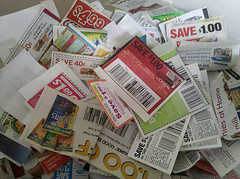
So many coupons! Photo: Flickr user sdc2027.
Google has purchased daily deal aggregator Dealmap. There are now more than 400 providers of daily deals, a sector that may grow to $6.1 billion by 2015. (New York Times)

Your takeaway: Keep an eye on these daily deal sites, but be wary. The bottom line is that you’re almost always going to have to discount your product by at least 50%, and consumers are loyal to the deal site brands (like Groupon or LivingSocial), not your brand. Do your homework before you commit. More information here.


The Washington Post reports that everyone is rebranding, from Honest Tea to non-profits, to the DC Water and Sewer Authority. (WaPo)

Your takeaway: In my experience, changing a visual brand (your logo, color scheme, tagline) is almost never worth the expense and headache, especially if you’re a brick and mortar business (just imagine purchasing new signage for hundreds of stores). But it CAN be worth it if there’s good reason to change. If you need to disassociate your brand story from a PR nightmare, or your visual identity is simply outdated, give some serious thought to what it would take, and what it would cost to rebrand yourself. Just read this story about the Gap’s experience before you jump in.


The most important story this week:

Remember how Obama lowered FICA by 2% as part of his economic stimulus? FICA is shorthand for the social security tax the government takes out of employee paychecks each pay period. In 2011, people collecting a paycheck received a 2% reduction in their FICA withholding, so paychecks got a bit bigger, whether folks received raises or not.

Unfortunately, as part of the recent debt ceiling debacle, this tax cut won’t be held over for 2012. This means that in 2012, the government will begin taking that 2% out again. The result? Workers collecting a paycheck will have more tax withheld starting January 1. People who don’t get a raise will have smaller paychecks, to the tune of $10 billion a month, or about $1,500 per working family for year. (Business Insider)

Your takeaway: That’s $1500 these families can’t spend on your product. What’s your plan to deal with this? You’d better start thinking now - about how to market more meaningfully (and less expensively), and how to stay relevant. Is your product a "want" item? Make it a need. Even if you’re a B-to-B outfit, if your customers sell to consumers, you’re still going to be affected.


What's on your mind this week? Please tell me in the comments.


Have a great weekend, and thanks for reading!

Marketing News Roundup - July 29, 2011

What should you be paying attention to this week?

Well, this whole debt ceiling issue is pretty distracting. It's hard to do business with so much uncertainty in the air. My clients are telling me that sales are pretty slow - most folks are taking a "wait and see" attitude before making any kind of committment.

In other news, more and more people are exploring Google+, and while reports say that the number of new users is leveling off, word on the street is that what we're seeing now is a Beta version, and there are many, many features to come, including special features for businesses. If you're not clear on how Google+ works, here's a video from the nice folks at Hubspot explaining the basics.


Are you on Google+? How's it working for you? Join me here and let's connect.

Have a great weekend, and thanks for reading!

Marketing News Roundup - July 22, 2011

What should you be paying attention to this week?

Most business executives now aware that social marketing is important, but have failed to create cogent social media strategies as part of overall marketing plans. (eMarketer)

Your takeaway? Do you have a social media strategy that supports the rest of your marketing plan? Social media can be time-intensive, so make sure that time is being used wisely.

Photo: Copyright John Rawlinson, Flickr


Fake Apple store in southwestern China best ripoff store ever, and just around the corner from, you guessed it, two more fake Apple stores. (NPR)

Your takeaway? Now's a great time to set up google alerts and other social media monitoring so you can see how your brand is faring online (and detect any fakes).

Time to take another look at coworking. Coworking offices are set up so that independent professionals have space to work and share ideas. The city of Santa Cruz is using it to help local talent find work. (Fastcompany)

Your takeaway? Why does the best talent for you to hire have to live somewhere in your geographic area and arrive in your office at the same time each day? Maybe it's time to think more creatively about getting the best people for your marketing team.

Have a great weekend, and thanks for reading!

Marketing News Roundup - July 15, 2011

What's new in marketing (and more) this week?

Everyone is watching to see how brand new social network Google+ is doing. Turns out that 75% of its users are male. Why? Early adopters of new technology tend to be males, and most Google+ users self-identify as software engineers or web developers, which are male-dominated careers. (Mashable)
salve-a-terra--twitter_4251_1280x800photo © 2009 Danilo Ramos | more info (via: Wylio)

Meanwhile, Microsoft seems to have given the Internet an accidental preview of its own social project, something called Tulalip. They're claiming it's an internal network, but nobody's swallowing that. (SocialBeat)

Internet movie giant Netflix has taken a real beating this week for raising its prices. Honestly, the new pricing seems more pain-in-the-rear than unaffordable, which gets me thinking that maybe Nextflix should have communicated this in a different way. How do you handle these kinds of changes? (PR Daily)

Customers turned to Twitter to share their Netflix woes, and Twitter turns five this week. 200 million users now post more than 100 million tweets daily. Founder Biz Stone had many reasons for creating Twitter, one of which was...boredom. What do you do when you're bored? (NPR)

Have a great weekend, and thanks for reading!