Pages

Showing posts with label leadership. Show all posts

Be Generous with Your Business


The New York Times recently reported that the key to happiness is giving to others. How can we apply this to our businesses? Here's five ways to give back:

From Flickr user ThisParticularGreg.
1) Help a less experienced colleague. People who do the same thing as you do are your partners, not just your competitors. Giving a little advice now and then is a way to make connections, give back, and great karma for later. Now is also a good time to look at how you're mentoring your own employees.

2) Give a customer a break. Have a difficult order with a return problem, shipping issue, or an "I'm just not happy" problem? Make that customer's dream come true. Give a full refund. Extend your return policy. Waive the shipping charges. Send a replacement for free. A little goodwill now will get you a customer for life.

3) Embrace your community. Do you reply to posts on Facebook? Do you retweet your customers' tweets? Do you help the recent college grads who follow your company on LinkedIn? Social networking is a two-way street. Don't just broadcast, contribute. You'll find that your Facebook wall becomes a vibrant community.

4) Get your company involved in local good works. How involved are you in the community where you live? It's easy to ignore our hometowns when we do all of our business online. Can you support your local Girl Scout troop? Kids' softball team? Food pantry? Get out there with your employees and find a way to help out in the community you call home.

5) Get your customers involved in good works. Ask them to donate to a good cause whenever they order, or just to support a favorite charity anyway. Donate a portion of their order to charity. Make it easy for them to share with their friends on social networks. 

How are you giving back? Please share in the comments.

Related Posts
Why Social Media Matters to Your Business
Why All Marketing is Local

Four Steps to Writing Copy With Passion

Whether you run your own small business or you're getting the word out about a worthy cause, a little passion goes a long way. If you're getting stuck while writing your next donation appeal, e-mail newsletter, or Facebook post, passion might be what you need.

Ready to write. From Flickr user Rob Pearce.
Here's four steps to adding a little passion to your copy:

1) Get rid of distractions, take a deep breath, and really think about why you got into your business in the first place. What did you what to achieve? Who did you want to help? Write it down. These are the seeds of the story you're going to tell today.

2) Now, ask yourself, "Why should people care?" Why do people need to donate to your cause, buy your product, or tell a friend about it? This is deeply connected to your answers to the first question. When you understand why you care about something, you can understand why everyone else should care.

3) Now that we've covered the whys, now let's get back to the what. What's the goal for the message you're writing today? To let people know about a great new product? To inform your audience about needy children who need help? To thank people for staying loyal to your business? When you understand the message goal, it's easier to write with passion.

4) Now, tie it all together. Explain why you care, tell others why what you care about is important to them, and then ask them to act. This is the root of your message and you use these passionate statements to write the appeal, newsletter, Facebook post, or anything else you're writing today.

Did this work for you? What do you do when you have writers' block? Please share in the comments.

Related Posts

How to Design a Great Email Newsletter
Removing Barriers to Social Media Engagement

The Introvert's Guide to Networking for Your Business

I spend a lot of time on this blog talking about how to market your business using online tools - be it your web site, email, social media presence, or search engine optimization. You've been working on all channels to bring in customers, get those sales, and meet your goals.

From Flickr user Kevin Shorter.
But who is taking care of you while all of this is going on? What's keeping you from eating breakfast, lunch, and dinner at your desk? Where are you getting new ideas, and with whom are you sharing them?

Yes, painful as it can be, you need to network!

You need some people to keep you sane, keep you inspired, and keep you on your toes.

I know how hard this can be - I am super-introverted myself. Large groups of new people exhaust me, but I promised myself that this year I would do more in-person networking anyhow.

I found out something really important when I began this exercise - if I have a small group of people where I can connect with each person authentically, my shyness disappears, and I'm able to offer value, and get something valuable from my networking experiences.

So how am I doing this? One thing at a time...

1) I looked at networks to which I already belong. I offered to plan some events for a book club I belong to through meetup.com. This seems like a pretty safe way to get to know the people in my club a bit better.

2) I'm keeping in touch with some old coworkers with monthly dinners to keep up on how people are doing personally, and professionally.

3) I'm meeting new people in my field on Twitter and LinkedIn, and I recently had dinner with one of them, which was lovely. Through that dinner, I've been invited to a lunch next month, which will be a slightly bigger, though still manageable gathering.

4) I am NOT attending large network events at bars that have 300 people at them. I know I won't get the value I need out of those experiences. They're designed for extroverts and I'm sure extroverted people have a great time at them.

5) I know myself and I use that knowledge to find the right networking moves for me. I know I'm best meeting people a few at a time, when I can really engage with each one of them. In this way, I can widen my circle gradually, but authentically. These new connections have given me great input, ideas, and inspiration.

What are your networking moves? I'd love to meet you so let's connect!


Your 2012 Strategy: Four People You Need in Your Network This Year

It's easier to meet your goals if you don't go it alone. Now that you have your 2012 plan put together, you've got to get your network together. Here's who you're going to need the year:


Twitter Network. Image: Sue Waters.
Your champion: Someone who may be able to offer funding and resources, and more importantly, open doors and make connections to get you the resources you need to move forward.

Your superintendent: Someone who can see the roadblocks ahead and keep you on track. A person who will make sure your marketing plan turns into actual marketing.

Your Jedi master: A big picture person who can help you see where you fit into the grand scheme of things and who has an instinct for future trends, needs, and happenings.

Your wingman/wingwoman: Someone who is always there to bring you hope when you feel discouraged. Someone who believes in you when the chips are down and who can convince you to dust yourself off and try it all one more time.

The good news: You already have these people in your life - you just need to identify them. Make sure you talk to them regularly - some leaders even get their entire brain trust together regularly to stay on track.

Who do you go to for advice, encouragement, or a reality check?

Are we networked yet? Let's connect on LinkedIn.

The State of the Union Address - "America is Back"

According to Obama, the State of our Union is "getting stronger."

It's always interesting to hear what the President has to say in the State of the Union address during an election year. As both an employee and a business owner (and a taxpayer, and a homeowner), I was looking forward to hearing what the President had to say about the economy.

If you watched the speech on whitehouse.gov, you could see an enhanced broadcast with charts and graphs to support Obama's talking points. I thought this was a great addition to the speech - the visuals really did put numbers behind the words.

The preview text of the State of the Union speech is here, from Huffington Post.

Here's some of what the President said on business and the economy:


On jobs: Obama says we should turn the unemployment system into a re-employment system that helps train people to get back to work with new skills, with critical involvement by community colleges and less confusing program structure. Other promises on innovation and jobs - immigration reform, the Dream Act, equal pay for equal work, and funding for research, American-made clean energy and biofuel powered fighter jets. He also proposed a Veterans' Jobs Corps to put Veterans back to civilian work after military service.


Obama's Blueprint For an Economy Built to Last is based on returning manufacturing jobs that have been shipped to American cities, where US employees are more productive than foreign workers. Obama wants to know what you can do to create jobs here in America. He's encouraging the rich to see a shared responsibility for the future of the country - rather than rewards for right now.

Stop businesses who ship jobs overseas: Obama wants to use tax incentives to bring jobs back here, and deny companies any tax incentive to move jobs away. American manufacturers should get big tax incentives for manufacturing here - help financing plants and hiring workers. He also wants to ship more US-manufactured products overseas.


On taxes: Warren Buffet's secretary, Debbie Bosanek, who pays a higher tax rate her boss, was seated with Michelle Obama. The President has promised to "level the playing field" on taxes, renewing the payroll tax cut and taxing people making a million dollars or more annually up to 30%. Can he do this without the support of Congress?


On mortgages and banking: "Living Wills" for banks in case they should fail, and a chance for homeowners who wouldn't qualify for current mortgage programs to refinance at historically low rates, with banks picking up some of the costs. "It’s time to apply the same rules from top to bottom: No bailouts, no handouts, and no copouts."

The new Unit on Mortgage Origination and Securitization Abuse to investigate the abuses that contributed to the financial collapse. Let's hope this one has some teeth - usually recommendations by these kinds of commissions are voluntary for banks and other bad actors.


Visions: A future with innovation and  manufacturing, where responsibility is rewarded and we are innovators in education with dependable long-term prosperity, where everyone gets a fair shot and does their fair share. Obama states these are American values.

Remembrances: Post WWII prosperity, which wouldn't have been possible without strong manufacturing and the huge GI Bill - an enormous government investment in helping veterans prosper. Obama wants to party like it's 1944.


The only problem with all of this: Obama kept saying "Send me a bill" for all of these policies. What are the chances of Congress doing that? If you want Congress to pass any of these bills, click here to locate your Member of Congress and contact them.

My forecast: I sure hope some of this can happen - better mortgages, more manufacturing jobs, equal pay, a ban on insider trading by Members of Congress, consolidated bureaucracy - all of this would help. Not sure how much we'll see before the 2012 elections, though.

Your 2012 Strategy: The Best Marketing Team for Your Business

As you continue to get your marketing strategy in order for 2012, it's time to give some thought to your marketing team. Is energy and time being spent in the right way to grow your business? Successful markeitng teams have these bases covered:

Teamwork. Photo: Flickr user Dawn (Willis) Manser.
Writing: Poor writing can derail even the most well thought out campaigns. Someone should be on top of your grammar, syntnax, and spelling, and be making sure to write in a way that appeals to and connects with your target audience.

Data: If you don't understand your customer data, you're marketing in the dark. If you don't have any data expertise on your team, consider hiring a consultant to train you on how to read your data and segment your customers.

Project Management: You need a real stickler to make sure your campaigns go out on time to the right audience and that you have the inventory to support them. Marketing can go terribly wrong if no one's paying attention to logistical matters.

Strategic Planning: Successful marketing plans align with your overall business goals, available resources, long range plans, and the channels and tools you plan to use. Without strategic vision, you'll just be sending out emails and posting on Facebook with few results.

Need help getting your marketing team aligned around the expertise you need to drive your business? Let me know - I can help.

Thoughts for the End of 2011

If you can't quite recall everything that happened in this action-packed year, here's the condensed version, courtesy of JibJab.

Goal.From Flickr user Opopodopo.
Now's a good time to reflect on your own goals for 2011 - how did you do?

I set a number of goals for 2011 - maybe too many...

There were a couple of big ones for me - starting this blog, and also finding a new gig for my main source of income, both of which I did. This enabled me to meet some other financial goals I'd set for this year.

There were others (for health and wellness), where I made strides but didn't get where I wanted to be, and still others (for continuing education) that I just couldn't get to.

So, what's the lesson here? 

First, it's important to congratulate yourself on what you did get done. I'm really proud of my new client relationships and I feel like getting my own blog and Twitter feed this year were key in supporting those.

Second, it's healthy to acknowledge where I made progress - I am exercising more and eating more healthfully, but there are continued improvements I need to make.

Third, examine what you couldn't get done this year and why - I didn't make time to take any classes, but I did get a lot of other things done. I had to deprioritize this goal because finding new sources of income and working on my health and wellness were more important.

So what about the coming year? What are your goals for 2012, for yourself and for your business? Here are some of mine...

For 2012, I'd like to work on growing my online audience and doing some more in-person idea sharing and networking. I want to continue the strides I've made in the health and wellness department, and also make a more conscious effort to pursue educational activities in whatever form I can find. If I can't take a semester-long class, webinars and one-off lectures can also work. I got a theramin for Christmas, and I'm looking forward to learning to play it as well.  


If you're a bit stuck on setting workable goals, here's a very useful article from Washingtonian about setting resolutions you can keep. Try not to set too many goals at once, and make sure they specific and measurable.

Happy New Year, and thanks for reading! Wishing you all a successful 2012!

Some Holiday Thoughts for 2011

From Flickr User ThisParticularGreg.
The week before Christmas is always so hectic, whether you celebrate the holiday or not.

People running around, getting ready to be away from work and school next week, and getting all that last minute baking and shopping done.

I'm not going to give you any new marketing advice this week - though if you have any super last-minute promotions, now's the time - but encourage you to take a minute to remember why you're in business in the first place.

What's the most important thing about your business?

The people.

Your employees, partners, vendors, clients and customers. 

You might have an A-1 business plan, the latest technology, and a super-cool product, but it won't make a difference if you don't honor, respect, and connect with the people in your working life.

Take some time today to say thanks - to your customers for buying, to your vendors and clients for doing business, and to your employees and partners for their support. Without recognition and positive energy, your best customers and employees will be seeking greener pastures. Your vendors perform better when they know you appreciate what they do.

I also want to thank you for reading this blog and for doing business with me. Without your support, feedback, and wonderful projects, I wouldn't be here. I hope that you and yours enjoy a warm, wonderful holiday season this year as a wonderful prelude to a successful 2012.

Time to Set Your Business Goals for 2012

So your holiday season is cooking along - you got through Black Friday, Cyber Monday, Green Monday, and hopefully you're all signed up for Free Shipping Friday, which is coming right up on December 16th.
Martini. Flickr user Adrian Hoffmann.

Take a little time out of the hustle and bustle to think about some key priorities for 2012. These may include:
Maximizing. Make a new years resolution to explore the potential on top of a new channel, like mobile or social. If you're already there, then maybe it's time to look at your PR or advertising in a new way.
Organizing. How do you organize your web content, photos, videos, enewsletters, and other assets? Are they managed in a way that makes them easy to find and allows for easy re-use? If not, it may be time to revisit your content management systems.
Motivating. Your salespeople (whether you have one or one thousand) need inspiration to keep on moving. Take another look at your incentive program. Are the incentives attainable? Are rewards frequent enough (monthly or quarterly) to keep people motivated? Is everyone participating? If the answer to these questions is "no" then revamp your program and see your sales rise as a result. People are not robots - they need to be incentivized, recognized, and rewarded to perform.
Networking. It's hard to get out there when we're so busy. If you're not a regular networker, challenge yourself to meet some new people this year. If you're not active on LinkedIn, set a goal of joining a group and participating regularly this year. If you're already there, challenge yourself to get to at least one live event in the first three months of 2012. If you're actively networked but your employees aren't, help them get started - new contacts benefit everyone in your organization.

What do you want to accomplish in 2012 and how will you get there? Please share.
Need help putting together your plan for success? Let me know.

News this Week: Black Friday, Cyber Monday, Niche Social Networks

What should you be paying attention to this week?

Don't forget about some of those smaller, niche social networks, like Instagram, Pinterest, Foodspotting, and one of my favorites, Ravelry, which is for knitters. (Mashable)


Holiday cheer from Flickr user John-Morgan.
Your takeaway: Think about applications for these carefully. It can be time and energy-consuming to put yourself on yet another social network, but if you can make one of these work for you, you'll have far less competition on something like Pinterest than, say, Facebook.

Black Friday 2011 has been judged a success, with the National Retail Federation estimating sales up $11.5 billion over 2008 sales and up $7.5 billion over last year. Retailers really pulled out all the stops this year - some even opening on Thanksgiving itself to boost sales. Many (though unfortunately not all) consumers had a better year in 2011 than 2010 - paying off debt and saving more, leading to more spending this year.

Cyber Monday 2011 was also bigger than ever, a 33% jump over last year, with social media and mobile (especially tablet) use contributing to the numbers in more significant ways. Customers looked for recommendations, shared deals, and did their comparison shopping, and ended up spending more than expected.

Your takeaway: I hope your Thanksgiving strategies boosted your business this year too, but there are still plenty of people who aren't going to be able to give their families the holiday they wish they could without a little help. Enough people had a better year this year to boost holiday retail sales, but there are still millions of people out of work who could use a boost. If you have means, consider giving a little more to your favorite charity this year.

What's Getting in Your Way?

Is there something getting in your way? Something keeping you from moving to the next stage of the game? If you're having trouble moving forward right now, today is a good day for a little business therapy.

Tito may be keeping me from full combo score on my dance game.


Some things to think about...

1) On what issue exactly are you having trouble moving forward? Creating a budget for next year? Completing your marketing plan? Putting together a press package? Identify where you're getting stuck.

2) Do you have too many goals? Just as it's probably not a good idea for a person to try to lose 30 pounds, get a new job, and learn a foreign language all at the same time, you might not want to try a creating a formal forecasting process, 5-year business plan, and a first-time press package all in the same 30-day period. Figure out which goal is the most important to get to first, and work on that. Sometimes giving certain projects a little rest can be immensely helpful. You'll come back later with fresh perspective and renewed energy.

3) Do you need help? Remember that it's OK to ask for help. This is where your network becomes a huge resource. Ask folks in businesses like yours (and different) how they are dealing with the issues you've been having. This is a great way to get some creative solutions, and make deeper connections.

What's holding you up? I'm here to listen, so drop me a line.

Related Posts

How LinkedIn Can Help You Build Your Business

Setting Your Goals


News This Week: Steve Jobs, Google+

What should you be paying attention to this week?

From Flickr user Monoko.
It turns out that Google's senior management isn't using Google+. (Mashable)


Your takeaway: Do you and your employees use your product? If not, why not? Even if you wouldn't naturally be the target audience for your offering, find a way to use it.

The major (and unfortunate) story this week is that Steve Jobs has died from pancreatic cancer. He's the reason we have icons on our desktops, we use a mouse to navigate, and that computer use is accessible to people who aren't engineers. You're reading this blog thanks to technology that Steve Jobs and his Apple colleagues pioneered. We're all forever in his debt for unleashing the power of the computer to the masses. The Internet is full of tributes to him, and questions about what Apple will do now. One of my favorite Steve Jobs quotes is:

"Your time is limited, so don’t waste it living someone else’s life. Don’t be trapped by dogma — which is living with the results of other people’s thinking. Don’t let the noise of others’ opinions drown out your own inner voice. And most important, have the courage to follow your heart and intuition. They somehow already know what you truly want to become. Everything else is secondary." 

Your takeaway:  Life is short. Now is a good time to re-evaluate what you're doing with your time, and with your business and your brand. Do you like what you do? Are you proud of it? Is it a good fit with your values? Are you making progress? If you're answering these questions with "no," think about other directions you might consider.

Have a rejuvenating weekend, and thank you for reading my blog. 

Building Your Brand

Brand. From Flickr user DentalBen.
What's your brand?

Your company name? Sure.

Your main product? OK.

Your visual identity - your logo and colors? All right.

That's a start.

But the strongest brands mean something. The strongest brands stand for something.

Now it's time for you to decide what your brand stands for.

Here's a simple exercise to get you started - ask yourself these questions:

1) What do you do? This is the core of your brand. Do you make clothes for children, sell organic produce, provide computer repair service, help people plan vacations?

2) How are you different than the competition? This is your value proposition. Are those children's clothes more affordable? Is the produce locally grown? Is the computer service guaranteed? Are the vacations more luxurious? These key differentiators help you articulate the value you offer to your customers.

3) What do you stand for? The very best brands are memorable because they stand for something larger - something bigger than a product or service. Do you believe that great children's clothes help kids stay more active and learn more? Do you believe that locally-grown organic produce is the key to our health and our economy? Do you believe that businesses are hurt by poor IT service? Or do you believe that travel can be a transformative experience that causes people to change the world?

Attempt to answer these questions, and you'll be closer to understanding how to strengthen your brand. These answers should be reflected in all of your communications - from your in-store merchandising to your catalogs, to your web site, PR, and social media.

You'll notice that I didn't say a word here about your logo, colors, or company name. While these things can make a difference to your business, the real difference is defining what stands behind them.

Need help articulating your brand? Drop me a line.

How LinkedIn Can Help You Build Your Business

You're a consumer-oriented business, so you don't need to be on LinkedIn, right?

Wrong. There's plenty on LinkedIn for you, even if you're not using it to sell directly to your customers.

Chain links. Photo: Flickr User Horia Varlan.
1) It's a great place to connect with others practicing your craft. Join groups, keep abreast of the news, and share ideas with folks who do what you do.

2) It's a great place to find vendors. Need an accountant? Need a PR or marketing manager? You can go on LinkedIn to read profiles and recommendations, and then connect to do business with just the click of a mouse.

3) It's a great place to recruit new employees. Search for the expertise you need, post open positions, and recruit. Find people who know people you know - people you can trust.

If you're looking for more ways to use LinkedIn to build your business, click here for an excellent post from Guy Kawasaki. 


Are you on LinkedIn? It would be great to connect with you there. Click here to connect with me.

News This Week: Target, Twitter, Jobs

What should you be paying attention to this week?


Sold-out Missoni suitcase. Image: Target.


The price of success: Target's Missoni sales event generated more traffic than on Black Friday, and more traffic than its site could handle, locking out desperate Frugalistas for hours. (Consumerist)

Your takeaway: Do you know how much traffic your site can really handle? What's your backup plan? Do you need to expand your bandwidth? Now's a good time to investigate your limits, just in case.

Because knowing is half the battle: In an appeal to businesses, Twitter launches a new analytics tool. The new Twitter Web Analytics will help users understand how their web properties are shared across twitter, how much traffic twitter drives to their sites, and measure usage of the Tweet Button application.  (Social Media Today)


Your takeaway: According to this study, Twitter influences more purchases than Facebook, so this is great information to have all in one place. At the moment, the new tool is only available to a small group, but be sure and give it a whirl once it's available to everyone in a few weeks.

The word of the day is "job": Last week, I wrote about the American Jobs Act, which President Obama debuted in a speech on September 8th. This week, Congressional Republicans have drawn a line in the sand about taxes (they don't want to raise them), so it remains to be seen what will happen with the bill. In the mean time, here are a few things you can do to create jobs while Congress gets its deal on.

What are you thinking about this week? Please comment or drop me a line.

News this Week: Jobs, Jobs, Jobs

What should you be paying attention to this week?

Whether you agree with his politics or not, I hope you watched Thursday's speech by President Obama.

Photo: Flickr user Buggolo
There are a number of things to think about.

1) If you're a small employer, there's a proposed tax cut for hiring anyone who's been unemployed for six months or more.

2) For manufacturers, the President has proposed making it easier to export your products all over the world.

3) If you're a visionary, Obama wants to make getting patents quicker and simpler.

4) More controversially, the President has called upon the richest of the rich and the largest, most profitable corporations to "do their part" and pay more taxes.

5) For the rest of us, a proposed income tax cut should save most families about $1500 next year.

6) There was also a great marketing angle to this speech. Obama repeated the words "Pass this jobs bill" many times. "Pass this bill now," he said again and again. He clearly messaged what he wanted and why. We can all take a cue from that.

What does this mean for your business?

It's hard to say. Certainly, the Republicans will oppose the plan, but Obama has also employed some strong rhetorical strategy - according to the President, people who are against the American Jobs Act are against building infrastructure, supporting products that are made in the USA by Americans, business tax cuts, and shoring up our educational system so we can be more globally competitive. Watch for a Republican alternative plan building on the prebuttal they already released, coming ASAP.

It will be interesting to see what the American Jobs Act looks like in the end, and how it will be paid for.

What do you think?

We can't end this week without considering how September 11th has affected all of us, our families, our lives, and our businesses. We all have our own memories of that day, and this is a good time to reflect on how we can value each other more and appreciate each other's differences.

Confident Consumers and Consumer Confidence

The Consumer Confidence Index®, which had improved a bit in July to 59.2, was down sharply at the end of August, to a worrying 44.5 - a 14.7 point drop.

Pensive piggy bank. Photo: Flickr user Bradipo.
How does consumer confidence affect your business?

Consumers are feeling pinched by gas prices, which remain fairly high, and poor job prospects, which aren't getting any better. Consumers surveyed felt that the short term outlook wasn't improving, and this means they are going to be holding off on purchases.

Couple this with the fact that negative customer reviews now mean more than ever, and you've got a recipe for slow sales.

So what do you do?

It's up to you to make your customers feel more confident - enough to buy from you for the first time, or to buy again. There are a couple of things you should consider here.

1) What's your guarantee? Do you have a 100% satisfaction guarantee? Customers want to know that you'll stand behind your product.

2) What's your return policy? If people change their minds, is it easy and quick to send it back?

3) How are you dealing with any negative reviews and problems? If you're not addressing these issues, and letting people know you are, people will be looking for a brand that's more reliable.

4) Like Mom said, don't you catch more flies with honey? Now is a great time to thank your customers for sticking with you during this difficult time, and to offer them incentive to shop with you again.

What about you? How are you sticking it out in these days? Drop me a line or leave a note in the comments section.

Related Posts

Dealing with Uncertainty

Four Ways to Keep Your Head Up in Tough Times

News this Week: Business Continuity and Emergency Planning

What should you be paying attention to this week?

Forecasted path of Hurricane Irene. Image: The Weather Channel.
News this week here in DC was dominated by the East Coast Earthquake, Hurricane Irene, and Steve Jobs’ resignation from Apple. (all from Washington Post)

This is has certainly been an eventful week. What’s your takeaway?

As a business owner, you need both an evacuation plan and a shelter-in-place plan to keep everyone safe.

But you also need to consider business continuity planning.

Who will make the decision to close your business in due to natural disaster or another event? If you have employees in multiple locations, how will each be affected? How will buildings be secured in case of damage?

Where will customer service calls be routed if your call center must be closed? If critical employees are affected by the disaster, who will take over for them?

Will people be able to answer emails remotely even if your email server is damaged? Can phone calls be forwarded to employees at home?

If your server room is damaged, where are your files backed up? Are critical documents stored in fire-proof containers?

What does your insurance cover? What is not covered and must be protected in another way?

You can find more information on business continuity planning here:

If you run your business out of your home, your business should be part of your family’s home emergency and evacuation plan. If you don’t have one of those, click here to get started.

What does Steve Jobs’ unfortunate situation have to do with this?

Now is also a good time to identify critical employees (yourself included), and what to do if they can't work. If you have an emergency and can't work, who will take over? Consider some cross training and succession planning.

What's this action packed week got you thinking? Please share in the comments or drop me a line.

Have a great weekend, and thanks for reading!

Your Role in Job Creation

The US Bureau of Labor Statistics reported a 9.1% unemployment rate in July, 2011, not good news. In some areas of the country, that rate is 20% or more. Don't forget that this rate is calculated using only people who are currently looking for work - people who have given up looking or dropped out of the workforce entirely aren't included. Neither are people who have part-time work but would prefer to work full time. So the true unemployment rate could be far higher.

Photo: Flickr user SahajaMeditation.
So what's your role in job creation? What can you and I do to help?

1) If you're able to, hire someone. Even part-time. Even 1099. Even just for one project. Every bit helps.

2) If you really, really can't hire anyone to work for you, think about things you used to hire other businesses to do, that you've started doing yourself for the past few years. Can you farm out some graphic design, accounting work, marketing, or PR to help another business? Again, every bit helps.

3) If your clients are other businesses, how can you provide even better service than you've been providing? If you help your clients grow, then they can do their part in job creation, too.

What about you? What are you doing to help create jobs, even as the economy stays challenging?

Dealing with Uncertainty

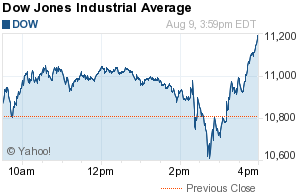
With all of the uncertainty and volatility in markets across the world right now, it's really hard to forecast or predict what's next. Looking at last year's pattern just won't cut it. It's hard to plan a big sale or predict results when constant change is the new norm. So what can you do? Here's a few pointers:

DJIA Results from August 9, 2011. From Yahoo! Finance.
1) Plan for disaster, but keep going. Schedule that grand opening. Have a sale. Send out some e-mails. Write that press release. Update your blog. Do a Facebook promotion. But understand that something as big as the debt ceiling debacle (and the super-fun it's caused) can happen anytime. Just because stuff happens, doesn't mean you stop doing business.

2) Redeploy underutilized assets. That's a fancy way of saying that if you have an eblast that no one read because all of your customers were paying attention to the shenanigans on Capitol Hill, tweak it a bit and send it out again. It'll save you time and design costs, and the message may take the second time around.

3) Be flexible and play out the what-ifs. What if your next sales event is hijacked by world events? Always have a Plan B. The best marketing plan is a flexible one. Be ready to reschedule, retrench, reboot, and restart. Think more carefully than usual when you order inventory and supplies. Don't order anything that can't be sold more than one way or any supplies that can't be repurposed.

4) Keep your head up. If you can get through now (and you got through the last thing), you can get through the next thing. Being resilient is key to survival. You can do it!

How are you getting through this crazy time? Please comment on this post.

Related posts:

Creating Your Marketing Plan
Four Ways to Keep Your Head Up in Tough Times