Pages

Showing posts with label marketing technology. Show all posts

News this Week: Kindle Fire, Holiday Sales, Online Tracking

What should you be paying attention to this week?

Three new tools to help you track everything you do online - if you're terrible at keeping track of all that great content you see in your daily journeys through Twitter, Facebook and elsewhere, EgoArchive, Memolane, and Greplin can help.

Your takeaway: I don't know about you, but I'm a little squeamish about archiving my entire online life online. At the same time, I am always losing cool links. These might be worth considering if you're starting a blog or wanting to raise your social media presence, but can't keep your content organized. 
Holiday retail sales continue to be a bright spot, says the National Retail Federation, which just raised this year's sales forecast to $469.1 billion. (New York Times)


Your takeaway:
Here are four ways to stay relevant after Cyber Monday, including Free Shipping Day, which is December 16th. On the other side of the coin, if sales are doing so well, what's with so many empty shopping malls? This economy isn't all better yet.

The new Kindle Fire already has software update on the way, due to several major complaints, including an unresponsive touch screen, slow browsing, and lack of privacy. (Washington Post)

Your takeaway: You can never do too much product testing. Make sure you're including people who are familiar and totally new to the product. Sometimes it's a good thing to slow your roll and get it right, rather than invite poor product reviews and disgruntled customers.
What's up with you this week? Drop me a line and let me know.
Have a good weekend, and thanks for reading.

The Facts About Mobile Marketing

I've been talking a lot about mobile marketing on this blog lately - ruminating about the wisdom behind investing in mobile apps, thinking about how customers use their mobile phones while they engage with your brand, and reporting on current mobile news.

That's all fine and good, but it's important to take all of this with a grain of salt.

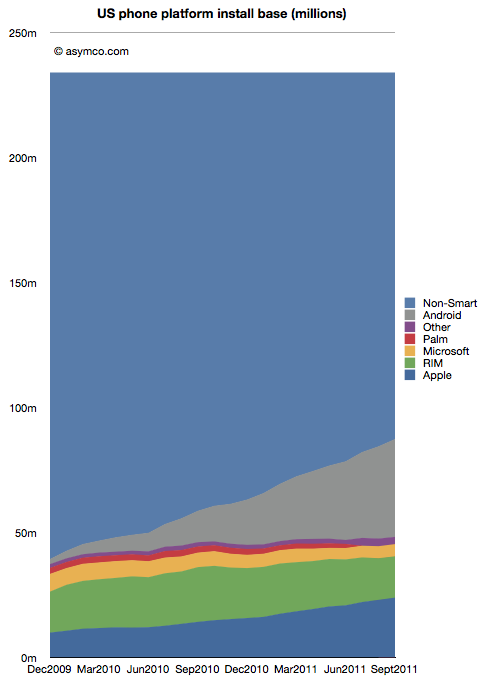
Chart from Business Insider/Asymco.
Why? Check out this chart, from the folks at Business Insider and Asymco. I'm reposting it here, because it's really, really important. 

What stands out? While the US still has the largest smartphone market (China is catching up), only 37.4% of mobile phone users have a smartphone. Android is the most common, with 39 million users. Apple smartphones have about 24 million users.

So, what does that mean? 


Although smartphone adoption is continuing to rise, the vast majority - 62.6% - are not on a smartphone. That means many of your customers can't use all those fancy apps - they can't use your special app, they can't find you on Yelp or RedLaser or anything else, they can't download coupons or reviews or anything else.

So, how do you reach them?

This is why you have multiple channels - you'll need to keep paying attention to your web site, support a robust email program, and (gasp!) answer the phone to make sure you're reaching everyone, unless all of your customers are urban, high-income people between the ages of 25 and 39. And don't forget good, old fashioned text messaging. One of my favorite local bars handles free dessert coupons via text - that's right - no fancy app, no downloads- just a text and a free dessert.

Need help reaching a diverse customer population? Let me know - I can help.

Your Business and Mobile Users

So you're feeling pretty good about your multi-channel strategy - you're using a good mix of social, PR, advertising, online, mail, and whatever else you can think of.

Then, like lots of people, you find out from the nice folks at Pew Internet that half of adult cell phone users have apps on their phones. That rate has doubled in the past two years and will likely continue to increase as people trade in their old phones for new smartphone devices.

Android. Flickr user osde8info.

Crap, you say. Another channel to manage? But I'm already customizing content for so many channels. I just can't take on anything else!

Not to worry, you're going to be OK. Here's what to do:

1) Just because people are using apps, doesn't mean you have to invest in your own mobile app. Just make sure you're available to mobile users in a variety of ways, like, for example:

2) Be available on popular check-in apps, like Foursquare. You want to be findable and sharable.

3) People do a lot of comparison shopping on their smartphones while they are shopping in your store, so make sure your prices are available on comparison shopping apps like Price Check and RedLaser.

4) People also look for restaurants, coffee shops, bars, and other hangouts using their phones, and check reviews on the way, so if you have this kind of venue, make sure you're findable on Yelp and Urban Spoon.

5) Last but not least, make sure your site is optimized for mobile. If you're going to invest in mobile, this is where your dollars should go, long  before you develop your own app, which you might not even need.

Still going crazy with too many channels? Drop me a line. I can help.

News this week: Places Facebook isn't used, Online Shopping, Blackberry Outage

What should you be paying attention to this week?

Blackberry. Flickr user Arrayexception.
In more bad news for Blackberry maker Research In Motion, which is really taking a hit from the more popular iPhone and Droid devices, a huge Blackberry outage spread this week from Europe, the Middle East, Africa, and South America on to parts of the US and Canada - seems to be stemming from a switch problem. (Mashable)

Your takeaway: No matter what kind of device you use most, think about what you'll do if it's not working. I always stay a few tweets and Facebook posts ahead using tools like HootSuite, just in case. My email and contacts are backed up in a couple of different ways, and so are my other files.

Artist Ian Wotjowicz has used maps from NASA to generate a picture of where Facebook has the most users, and which places it hasn't penetrated. Still available for Faceover are places in Asia and North Africa. (Business Insider)

Your takeaway: You probably don't need to take over the world to grow your business, but it's a good idea to regularly investigate your geographic reach and see where it would be logical to grow next. It can be especially useful to map your customers by zip code to see if there are areas that could use a little advertising love.

In a startling statistic out of Britain, it turns out that 40% of UK online shoppers make more than one online purchase per week. (Retail Week)

Your takeaway: If you're only talking to your customers once a month, that's probably not enough to keep your brand top of mind. Think about increasing the frequency of your email marketing program, and adding channels like Facebook or Twitter to get the word out more often, especially to multi-buyers. Don't ignore traditional channels like print ads and direct mail, either. A well-rounded marketing plan works best.


Have a great weekend, and thanks for reading!


News This Week: Steve Jobs, Google+

What should you be paying attention to this week?

From Flickr user Monoko.
It turns out that Google's senior management isn't using Google+. (Mashable)


Your takeaway: Do you and your employees use your product? If not, why not? Even if you wouldn't naturally be the target audience for your offering, find a way to use it.

The major (and unfortunate) story this week is that Steve Jobs has died from pancreatic cancer. He's the reason we have icons on our desktops, we use a mouse to navigate, and that computer use is accessible to people who aren't engineers. You're reading this blog thanks to technology that Steve Jobs and his Apple colleagues pioneered. We're all forever in his debt for unleashing the power of the computer to the masses. The Internet is full of tributes to him, and questions about what Apple will do now. One of my favorite Steve Jobs quotes is:

"Your time is limited, so don’t waste it living someone else’s life. Don’t be trapped by dogma — which is living with the results of other people’s thinking. Don’t let the noise of others’ opinions drown out your own inner voice. And most important, have the courage to follow your heart and intuition. They somehow already know what you truly want to become. Everything else is secondary." 

Your takeaway:  Life is short. Now is a good time to re-evaluate what you're doing with your time, and with your business and your brand. Do you like what you do? Are you proud of it? Is it a good fit with your values? Are you making progress? If you're answering these questions with "no," think about other directions you might consider.

Have a rejuvenating weekend, and thank you for reading my blog. 

News this week: Daily Deals, Social Networks, Customer Reviews

What should you be paying attention to this week?

Photo: Tim Malone, www.timmalone.id.au.
Is the daily deal bubble bursting? Facebook and Yelp getting out of the daily deal business, Groupon traffic is down 50%. I agree with the folks at Mashable, who say that customers will always appreciate a great deal, but this concept has reached its saturation point in the US. (Mashable)

Your takeaway? Here are my two cents on the daily deal concept. While the trend isn't over and will continue to evolve in different ways, it's still important to make sure it's financially advantageous for you to participate. You can always do your own coupons to your own customer list without these deal sites if you want.

65% of American adult Internet users are on social networks like Facebook, Twitter, and Google+, according to a new report from the Pew Research Center. This is up 4% from last year. The Baby Boomer generation is seeing the most significant growth, up 60% over last year. (Pew Internet)

Your takeaway: If you're not participating in at least one social network, it's time to try this out. You don't have to be on all of them, but test Facebook if you're consumer-oriented, or LinkedIn if you're B-to-B. Also, if your customer cohort is age 50+, you officially have to stop ignoring social media - your customers are on it and they'll be looking for you there.

Negative customer reviews growing more powerful, with 80% of consumers indicating that they've changed their mind due to negative reviews of a product which they were considering. On the flip side, 87% of consumers surveyed said that positive reviews helped them decide to make a purchase. (MediaPost)

Your takeaway: It's always a good idea to allow customers to review your product. If you do, make sure you also have the ability to respond publicly to poor reviews and resolve customer issues. Bad reviews can be overcome if you'll step up and make it right with those customers.

What's on your mind this week? Please share in the comments.

Have a great weekend, and thanks for reading!

Weekly News Roundup - August 20, 2011

What should you be paying attention to this week?

It’s getting easier to put up a storefront on your Facebook page, thanks to a partnership between Facebook, e-commerce platform provider Magento, and service provider Zibaba. Say that ten times fast. (Internet Retailer)

Your takeaway: If you’ve been wondering how merchants like LL Bean and Petco got their Facebook stores up and running, it’s going to get easier. If you do a lot of online sales and Facebook is (or you want it to be) a major customer channel, now’s a good time to start thinking about what it would take to do this.

Google, among other things this week, has launched a catalog app for the iPad. Also coming soon for Android, Google Catalog lets users flip through digital catalogs, go shopping, and share with friends.  (Time Techland)

Your takeaway: If you've got a catalog, and you sell to a relatively affluent audience (i.e. people with iPads), then this is something you might consider. The more convenient you make shopping for your customers, the better.

Gotorola or Motoroogle? Never one to rest on its laurels, the real big story for Google this week is the acquisition of Motorola Mobility. This is a good news/bad news situation (ZDNet)

What does it mean that Google will now own its very own mobile device manufacturer? Google will be more like Apple – they will supply the software platform and the device hardware, as well as the content and apps they already provide.

But let’s not forget that a huge motivator for Google’s acquisition was to strengthen its position in the patent wars – here’s more on these from NPR, including a handy graphic that explains who’s suing who.

But as ZDNet says, this also means that Google will then compete against the very handset makers using its Android platform – Samsung, HTC, etc. Isn’t this a bit cannibalistic?
Of course, Google could always just shut Motorola down completely and keep the patents, and there’s always a chance they could do that, but I hope not. That’s a lot of jobs we can’t afford to lose.

What do you think the Google acquisition of Motorola means for technology, jobs, telecom? Please share in the comments.

Have a great weekend, and thanks for reading!

How to Find Better Customers

The last couple of years have been hard on retailers. Customers expect sale after sale, more and more discounts, incredible service, and tons of freebies. And loyalty? Forget it. There's always another deal around the corner.

Photo: Flickr user Zizzybaloobah.
So how do you find better customers?

Reward the behaviors you want, and discourage the ones you don't.

First, examine your best customers.

How profitable are they? What are they buying? Are they on your email list? Do they follow you on Twitter? Are they your fans on Facebook? What's converting them to buy, and buy again?

In the process of this examination, you might find that your best customers are frequent responders to your Facebook promotions. That's great, but how can you use this knowledge?

Second, reward the behaviors you want.

If Facebook is your most profitable channel, then make your promotions even more profitable by crafting deals with the greatest possible margins.

Encourage customers on all channels to join you on Facebook as well. If your Facebook promotions are generating the most profitable customers, the more fans you have, the better.

Third, discourage the behaviors you don't want.

Which customers are the most expensive to serve? How can you redirect them to more profitable channels? If you find, for example, that customers who call your call center are the least profitable, consider adding more ways in which to serve them, perhaps encouraging them to use instant messaging, online resources (your FAQ are comprehensive, right?) or Twitter to ask questions.

Re-examine your shopping cart - is it too difficult to buy online? If you have a two-screen process, can you get it down to one screen? Can you highlight the safety and security of your shopping cart process?

At the same time, make sure your customers still have several options for both sales and service- your stores, call center, web site, and email. You don't want to turn people off unless you're absolutely sure you don't want their business.

What are you doing to reward your best customers? Please share in the comments.

Marketing News Roundup - August 12, 2011

What should you be paying attention to this week?

Besides continued uncertainty?

Groupon gets mixed reviews from merchants. 82% of merchants surveyed unhappy with their Groupon experience, but 45% willing to try again. (eMarketer)

The only thing that's certain is more uncertainty.
Photo: Flickr user Patrik Jones.
Your takeaway: The verdict is still out on these kinds of deal sites. I’ve said this before and I’ll say it again. First, really price this out – you’re going to need to discount your product between 50% and 90% to work with Groupon and similar sites. Do your math ahead of time! Second, customers are loyal to Groupon, not your business, so the number of new, loyal customers you get may not be as high as you think it’s going to be. If you’re OK with both of those things, give it a try, but keep your eye on the news – more and more stories are surfacing that Groupon itself may be financially insolvent.


E-Commerce spending up 14%. $1 of every $10 in discretionary spending now happens online. (Washington Post)

Your takeaway: Take a few moments in the next week to sit down with your web analytics software and examine your shopping cart funnel. Could you lower your abandon rate with an easier sales process, a more noticeable callout about data security and privacy, or a reminder email strategy?

Also, don’t forget that this still means that $9 of discretionary spending happens offline. If you sell your product through both online and offline channels, make sure these work together to capture customers, however they like to buy.


People are starting to experience social network fatigue. Rather than connecting to friends and family, people simply feel pressured to check and update their networks without getting a lot of value out of them. (New York Times)

Your takeaway: Focus on the social networks where your customers are. Don’t waste time trying to sell your homemade scented soap on LinkedIn or your extremely technical e-commerce solution on Facebook. Use management tools to pre-schedule posts to multiple networks, but make sure you do a bit of customization – I can usually tell when something written for Twitter winds up on Facebook (complete with #hashtags) and this is a heads up to customers that you’re taking some shortcuts.

What's going on with you this week? Tell me in the comments.

Have a wonderful weekend, and thanks for reading!

Why Social Media Matters to Your Business

I've worked with a number of businesses now that were a little afraid of engaging with customers on social media. Online. Where everyone can see.

Listen to your customers and they will listen
to you. Photo: Wayne Large, via Flickr
What are they worried about?

"Anyone can follow us!"

"We can't control what they say!"

"People can complain publicly about our product!"

"This will change our reputation!"

Sorry people. These aren't bad things - these are great things for your business.

Let's break this down, one misconception at a time:

"Anyone can follow us!"

That's right. Anyone can follow you on social networks - people who already love your brand, people who have bought from you once, people who are thinking about buying your product, people who want to learn more, AND all of their friends, and their friends, and their friends too. So, if you're opposed to this, you're saying that you really don't want to increase your reach and you really don't want to let more people know you exist. What kind of business doesn't want to grow? You tell me.

"We can't control what they say!"

That's right - people can say what they want. They can talk about ways they are using their product that you haven't even thought of, little bugs you might not have even noticed, other stuff they wish you would sell, and ask you questions about how to use it. They can also talk about how much they love, love, love what you do, and tell their friends all about it.

"People can complain publicly about our product!"

It's true. People can complain as much as they want, and tell as many people as they please. This is what most businesses are afraid of, but I promise that this is a good thing. When customers complain publicly, you have a chance to make it right, also publicly, and then that customer will thank you and appreciate you, also (you guessed it), publicly, for everyone to see. You know what your future customers want? Not just a great product, but a company that stands behind that product and makes it right when there are problems. Here's your chance to prove it.

"This will change our reputation!"

Yes it will. You'll be known for real love instead of polite disdain. You'll be known for closeness instead of distance. For care instead of neglect. For engagement instead of willful ignorance. I don't see a problem here. If you do, then you need to reexamine why you're in business to begin with.

Need help going social? Let me know.

Be social with me - I'm on Twitter and Google+.

Marketing News Roundup - July 29, 2011

What should you be paying attention to this week?

Well, this whole debt ceiling issue is pretty distracting. It's hard to do business with so much uncertainty in the air. My clients are telling me that sales are pretty slow - most folks are taking a "wait and see" attitude before making any kind of committment.

In other news, more and more people are exploring Google+, and while reports say that the number of new users is leveling off, word on the street is that what we're seeing now is a Beta version, and there are many, many features to come, including special features for businesses. If you're not clear on how Google+ works, here's a video from the nice folks at Hubspot explaining the basics.


Are you on Google+? How's it working for you? Join me here and let's connect.

Have a great weekend, and thanks for reading!

Marketing News Roundup - July 15, 2011

What's new in marketing (and more) this week?

Everyone is watching to see how brand new social network Google+ is doing. Turns out that 75% of its users are male. Why? Early adopters of new technology tend to be males, and most Google+ users self-identify as software engineers or web developers, which are male-dominated careers. (Mashable)
salve-a-terra--twitter_4251_1280x800photo © 2009 Danilo Ramos | more info (via: Wylio)

Meanwhile, Microsoft seems to have given the Internet an accidental preview of its own social project, something called Tulalip. They're claiming it's an internal network, but nobody's swallowing that. (SocialBeat)

Internet movie giant Netflix has taken a real beating this week for raising its prices. Honestly, the new pricing seems more pain-in-the-rear than unaffordable, which gets me thinking that maybe Nextflix should have communicated this in a different way. How do you handle these kinds of changes? (PR Daily)

Customers turned to Twitter to share their Netflix woes, and Twitter turns five this week. 200 million users now post more than 100 million tweets daily. Founder Biz Stone had many reasons for creating Twitter, one of which was...boredom. What do you do when you're bored? (NPR)

Have a great weekend, and thanks for reading!

Marketing News Roundup - July 8, 2011

What's new in marketing (and elsewhere) this week?

App to watch: Bitcoin, just launched to Android users. Bitcoin is a peer-to-peer virtual currency that's been around since 2009. No banks are involved and it's not mapped to any existing currency - users trade bitcoins with one another. This kind of digital wallet app makes me go hmmmm.... (Wired GadgetLab)
Textbookphoto © 2006 Amy | more info (via: Wylio)

In other app news, the Apple App Store reaches 15 billion downloads. Store now contains 425,000 different apps. Wow, that is a lot of apps (CNET)

Is it finally time to kiss costly college textbooks goodbye? Academic presses embracing much more affordable e-books. Definitely a boon for books with niche appeal and overall idea-sharing. So sorry, super-expensive university bookstore (um, not really). (Inside Higher Ed)

What's Google's new social platform, all about? Here's seven ways you can use Google+, if you can score an invitation.  (TheNextWeb)

Have a great weekend, and thanks for reading! What's news to you this week?

Related Articles:
Last week's news (in case you missed it)
Do you need a mobile app? (In case you want one)

Marketing News Roundup - July 1, 2011

What's new in marketing (and elsewhere) this week?

Fireworksphoto © 2011 Nigel Howe | more info (via: Wylio)
If you paid too much for your house, don't feel bad. At least you're not News Corp, which bought MySpace in 2005 for $580 million, and just sold it to ad network Specific Media for $35 million. Reports indicate that half of MySpace's staff will be cut. (All Things D)

Wondering what people are doing with their iPads? According to a new study by Business Insider, they're using them between 2 and 5 hours a day and downloading lots of apps. A whopping 39.7% of those surveyed indicate that their iPad is now their primary computer. Takeaway: If you haven't done so already, make sure you've tested all of your web properties on one of these devices. (The Atlantic)

How are Facebook, Twitter, and other social apps affecting your web traffic? Google has just made figuring this out easier with enhanced social performance modules on Google Analytics and Webmaster Tools. Thanks, folks! (Mashable)

Have a great holiday weekend, and thanks for reading!

Do You Need a Mobile App?

So a new report from Flurry claims that consumers are now spending more time using mobile apps than on the Internet (thanks, Mashable, for getting this some attention). Consumers are spending an average of 81 minutes daily using mobile apps vs. 74 minutes of web surfing.

So, this means you need to go right out and create your own mobile app, right?

Not exactly. We'll talk about this in a second.
android appphoto © 2010 clive darr | more info (via: Wylio)


The first thing you need to do (if you haven't already), is visit your web site while using your mobile phone, and the mobile phones of a few of your friends. What you see on your desktop isn't what you'll see on your Blackberry, Droid, iPhone, or tablet. Make sure people using any popular smartphone or tablet these days can use your site. 

Questions to ask:

1) Can they read your content or do they have to keep zooming in, zooming out, and scrolling back and forth?

2) Is your site fully functional via mobile? Can people order your products, access customer service, and easily navigate to your content?

3) Is there something most customers on a mobile would want to see first on your site, like maybe your phone number or directions? How can you make this easier for them to find?

So, now it's time to create your own app, right? Not exactly.

It can be expensive to get a developer to make you your very own app. So think about apps that are already out there that can be used to promote or access your business. Ask yourself:

1) Is your business available to people using social apps, like Twitter, Facebook, and LinkedIn?

2) If you're brick-and-mortar, are you sharable on check-in apps like FourSquare and SCVNGR?

3) If you run a restaurant, are you available on review sites like Urbanspoon, and reservation apps like OpenTable?

So NOW is it time for my own mobile app?

Sure. But really give some thought to a problem your mobile app will solve, and if there's an app already out there that can be used. After all, existing apps (like Urbanspoon, for example) already have a dedicated audience. If you make your own app, you're starting over.

Also, games are great and it's tempting to make your own game for people to play. But how does this help? Does it really get people to buy more of your product or is it just an opportunity for people to play at your expense?

That said, it can't hurt to talk with an app developer and see what kind of ideas they might have for you.

You might also consider holding an app development contest for your customers. See what they think you should be doing on your mobile.

All apped out? Let me know. I can help.

Marketing News Roundup - June 17, 2011

What's new in marketing (and elsewhere) this week?

Is the age of extremely conspicuous consumption officially over? Mercedes seriously considers dumping the Maybach, or just totally redesigning it. (Autoweek)

Students at Stanford have started a budget-by-text service that helps lower-income families budget and save by documenting their spending. What could you document that would help you better meet your own goals? (FastCompany)

Musician Kim Boekbinder has developed a way to fund her concerts ahead of time. Fans tell her where they want her to perform, and when there’s enough people to offset costs, she finds a venue that’s the right size and books a show. No more empty concert halls. No more cancelled shows and let-down fans. I love this way of empowering everyone but the major record labels (and really, why couldn’t they do this too? Might bring down the astronomical price of concert tickets, don’t you think?). (BoingBoing)
  
Facebook hires former Clinton Press Secretary Joe Lockhart to manage its image and relationships with government, media. (Complex)

Not really about marketing, but important nonetheless. What would society look like free of rank-ism? What is a dignitarian society, where everyone has the right to dignity? (CNN) 

Latest industry to benefit from social media? Food trucks, which can broadcast where they are right this minute and what they're serving today to a community of fans with confirmed interest in their product. (Mashable)

Have a great weekend, and thanks for reading!

Email Isn't Dead! Permission Based Marketing Works

Lately, lots of marketers have been refocusing on email marketing as a way to better sell, keep, serve, and save customers. Though proponents of social media have declared email dead, businesses like Groupon, LivingSocial, and SniqueAway have proved them wrong. So why does email do wonders where other channels can fail?

It's all about permission-based marketing.

That's right. While all channels can be (and should be) permission-based, e-mail is by far the easiest to optimize this way and generates the best results.

How does this work?
Email email emailphoto © 2010 Keith Ramsey | more info (via: Wylio)

On a basic level, you should only be sending your email blasts to people who've agreed to receive them.

But it goes deeper than that.

If you sell more than one type of product, don't you want to know which of your customers are most interested? If you sell products for babies, why do you want to promote these to people without babies? Why do you want to sell garden supplies to people who don't have gardens? Why do you want to sell windshield wipers to people without cars?

You don't. (No, you really don't.)

This is where permission-based marketing comes in. Here's how it works:

Ask your customers which kinds of messages they want from you - what are they interested in and what do you they want to hear about? You can work with your e-mail vendor on this, or you can use one of several online survey tools to ask them. Then, simply send them what they want.

Why is this good?
  • It helps you determine the level of interest for each of your product categories.
  • You're of more value to your customers because you're only delivering content of interest.
  • You're respecting your customer by letting them hear from you only as often or as rarely as they want.
  • When you launch a new product, you'll have a much better idea of how many people will want it.
 Need help figuring out who wants what, where and when? Let me know.

Marketing News Roundup - June 10, 2011

What's new in Marketing (and other things) this week?

Shopping center construction has hit a 40-year low, which isn't surprising if you stop and consider all of the vacant retail space you likely see in the course of your daily travels. Some people wondering if this is the end of big-box retailers while shopping shifts online. Target's sales have been slow, but I doubt the end is near. (Business Insider)
Target Signphoto © 2008 Ted | more info (via: Wylio)


Female prisoners in Oregon are being trained to start their own businesses upon release. Is entrepreneurship the wave of the future? I've seen a shift in thinking from lots of people in the last year - there's a new focus on business ownership as a way of creating one's own stability and opportunity, rather than reliance on an employer to do so. (NPR)

In another bright spot during a crazy news week, it looks like tech jobs, including those for web developers, technical writers, and content managers, are returning to the US after years of outsourcing. Companies are finding outsourcing arduous to manage and not that much cheaper in the long run. Told you so. (ReadWriteWeb)

Google makes another acquisition, buying online ad optimization startup Admeld for $400 million. This is good news for CEO Michael Barrett, who was last known as the fall guy for MySpace's failed revenue targets. (TechCrunch)

By the way, have you ever read the iTunes EULA?  Now you don't have to. The nice folks at CNET asked Richard Dreyfuss to read it for you. It's fabulous - click the link and scroll down to listen. (CNET)

Have a great weekend, and thanks for reading!