Pages

Showing posts with label marketing trends. Show all posts

Why You Should Start Caring More About Tablet Users


The tablet is truly disruptive technology that is again changing how we consume information and how we buy. Experts predict that there will be almost 55 million tablet users by the end of 2012, most of them on the iPad.

It's time to ask yourself more about how tablet use affects your business.

Here's three basic points for consideration: 

Who are tablet users? Tablet users are more likely than the general public to be college educated, high-income, employed full time, and have a median age of 30 to 49. Many have become dedicated tablet users, abandoning other devices, like phones and laptops, to do their surfing on their tablets. They are also brand loyal, preferring to get their content from trusted providers and people/businesses they know.

How does your web site look on a tablet? If you don't have one, get one, borrow a few of the different models from friends, or just go to your local big box store and say you're interested in a tablet and check them out.

How are people using their tablets? The best way to understand the tablet experience is to have the tablet experience yourself. Borrow, or if you're able to, buy one. Tablets are much easier to carry around than a laptop, with an ease of use and speed that's much better than many mobile phones. The large screens make for better browsing and easy social networking - people can get at mobile apps, web pages, games, videos, and other experiences with speed and ease.

So, what's your takeaway? What does this mean for you?

When you're thinking about mobile customers - customers on the go who might want to buy from you - increasingly you'll need to consider tablet users.

So make sure you're addressing the needs of mobile customers in all of your campaigns - be local, social, and accommodating, and consider your app strategy carefully.

Other trends for 2012? 

Business News Daily has some interesting trend predictions, including gesture recognition (it's not going to stop at Kinect gaming technology), universal shopping experiences (across mobile, web, and in-store), mobile learning, and increased franchising.

What are you up to this year? Drop me a line and let me know.

The Facts About Mobile Marketing

I've been talking a lot about mobile marketing on this blog lately - ruminating about the wisdom behind investing in mobile apps, thinking about how customers use their mobile phones while they engage with your brand, and reporting on current mobile news.

That's all fine and good, but it's important to take all of this with a grain of salt.

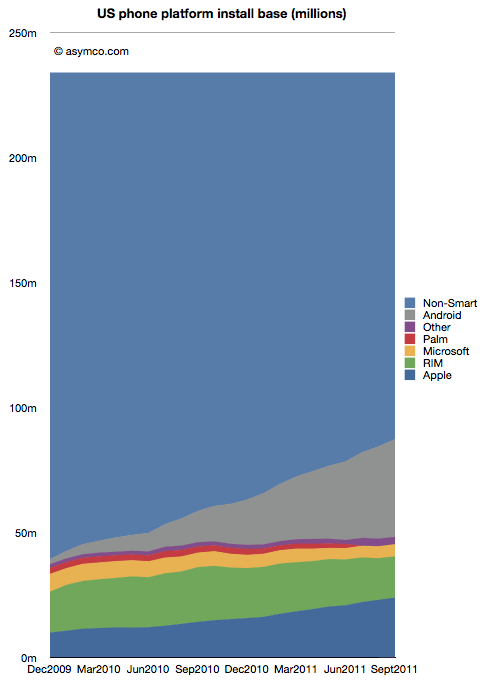
Chart from Business Insider/Asymco.
Why? Check out this chart, from the folks at Business Insider and Asymco. I'm reposting it here, because it's really, really important. 

What stands out? While the US still has the largest smartphone market (China is catching up), only 37.4% of mobile phone users have a smartphone. Android is the most common, with 39 million users. Apple smartphones have about 24 million users.

So, what does that mean? 


Although smartphone adoption is continuing to rise, the vast majority - 62.6% - are not on a smartphone. That means many of your customers can't use all those fancy apps - they can't use your special app, they can't find you on Yelp or RedLaser or anything else, they can't download coupons or reviews or anything else.

So, how do you reach them?

This is why you have multiple channels - you'll need to keep paying attention to your web site, support a robust email program, and (gasp!) answer the phone to make sure you're reaching everyone, unless all of your customers are urban, high-income people between the ages of 25 and 39. And don't forget good, old fashioned text messaging. One of my favorite local bars handles free dessert coupons via text - that's right - no fancy app, no downloads- just a text and a free dessert.

Need help reaching a diverse customer population? Let me know - I can help.

News This Week: Facebook Changes, Email Charter, Bank Fees

Tito is horrified by BofA. He can still get tuna, right? 
What should you be paying attention to this week?

First, Facebook has made some massive changes to the way user feeds look and information is organized. Some of the engagement tools are really cool.

On the other hand, early results are bad for small and medium-sized brands - those with only a few hundred or few thousand fans may find themselves disappearing from fan feeds. Check your Facebook insights to see if your impression numbers are affected. That's what I'm noticing for the corporate Facebook pages I manage. Look for fixes soon - there will have to be workarounds or brands will start giving up on Facebook, which Zuckerberg won't like. (Search Engine Watch)

Next, do you find that email is taking over your time, and not in a good way? I often feel overwhelmed by the sheer amount of email that I receive. I am a conscientious person who tries to read everything, but I sometimes find I'm deleting information that may be important because I know I'll never get to it in favor of trying to get to the stuff I know that I have to respond to, which is often more urgent, but less important. Check out the Email Charter, which is trying to change all that. I have to say I'm on board!

Finally, Bank of America is going to start charging customers $5 a month for use of a debit card, starting in 2012. This is as a result of Congress capping the fees that banks can charge retailers for accepting debit card purchases.   (Business Insider)

What does this mean for you?

Take a look at how many of your customers are using their debit cards to buy with you - these customers will now either have to pay cash or use a debit card to avoid this $5 fee. It's hard to say what kind of affect this will have - debit cards sure are convenient and $60 a year may not be enough to make most consumers avoid using them. Are people really going to stop using their cards? Early chatter is more oriented around customers boycotting Bank of America, rather than ceasing to use their debit cards. Definitely keep an eye on this one if your customers use debit cards.

Have a great weekend, and thanks for reading! What do you think of this week's  news?


Using Facebook to Drive Traffic to Your Store

Like most retailers, you've got a Facebook page. You put one up because you felt like you couldn't afford not to have one, and you were right.

Facebook. Photo: Flickr user Max-B
But having a Facebook presence is only the beginning. The Facebook page itself won't bring people into your store - you've got to turn it up a notch to really drive that traffic. What should you do to your page?

First, make it relevant.

Your fans want to know about your sales, specials, and upcoming events.

Second, make it engaging.

You can't spend all your time on Facebook selling - you'll turn people off. Try quizzes, contests, and questions to get people talking. Make sure you're checking back regularly to respond appropriately.

Third, make it trackable.

Use tools like Facebook Insights and Hootsuite to monitor your Facebook reach and engagement. You'll be able to see what kinds of posts generate the most comments, likes, and shares.

What are you doing on Facebook to make your presence known? Please share in the comments.

Related Posts

Why Social  Media Matters to Your Business

Three Ways to Drive Sales Today

Marketing News Roundup - August 5, 2011

What should you be paying attention to this week?

So many coupons! Photo: Flickr user sdc2027.
Google has purchased daily deal aggregator Dealmap. There are now more than 400 providers of daily deals, a sector that may grow to $6.1 billion by 2015. (New York Times)

Your takeaway: Keep an eye on these daily deal sites, but be wary. The bottom line is that you’re almost always going to have to discount your product by at least 50%, and consumers are loyal to the deal site brands (like Groupon or LivingSocial), not your brand. Do your homework before you commit. More information here.


The Washington Post reports that everyone is rebranding, from Honest Tea to non-profits, to the DC Water and Sewer Authority. (WaPo)

Your takeaway: In my experience, changing a visual brand (your logo, color scheme, tagline) is almost never worth the expense and headache, especially if you’re a brick and mortar business (just imagine purchasing new signage for hundreds of stores). But it CAN be worth it if there’s good reason to change. If you need to disassociate your brand story from a PR nightmare, or your visual identity is simply outdated, give some serious thought to what it would take, and what it would cost to rebrand yourself. Just read this story about the Gap’s experience before you jump in.


The most important story this week:

Remember how Obama lowered FICA by 2% as part of his economic stimulus? FICA is shorthand for the social security tax the government takes out of employee paychecks each pay period. In 2011, people collecting a paycheck received a 2% reduction in their FICA withholding, so paychecks got a bit bigger, whether folks received raises or not.

Unfortunately, as part of the recent debt ceiling debacle, this tax cut won’t be held over for 2012. This means that in 2012, the government will begin taking that 2% out again. The result? Workers collecting a paycheck will have more tax withheld starting January 1. People who don’t get a raise will have smaller paychecks, to the tune of $10 billion a month, or about $1,500 per working family for year. (Business Insider)

Your takeaway: That’s $1500 these families can’t spend on your product. What’s your plan to deal with this? You’d better start thinking now - about how to market more meaningfully (and less expensively), and how to stay relevant. Is your product a "want" item? Make it a need. Even if you’re a B-to-B outfit, if your customers sell to consumers, you’re still going to be affected.


What's on your mind this week? Please tell me in the comments.


Have a great weekend, and thanks for reading!

Marketing News Roundup - July 22, 2011

What should you be paying attention to this week?

Most business executives now aware that social marketing is important, but have failed to create cogent social media strategies as part of overall marketing plans. (eMarketer)

Your takeaway? Do you have a social media strategy that supports the rest of your marketing plan? Social media can be time-intensive, so make sure that time is being used wisely.

Photo: Copyright John Rawlinson, Flickr


Fake Apple store in southwestern China best ripoff store ever, and just around the corner from, you guessed it, two more fake Apple stores. (NPR)

Your takeaway? Now's a great time to set up google alerts and other social media monitoring so you can see how your brand is faring online (and detect any fakes).

Time to take another look at coworking. Coworking offices are set up so that independent professionals have space to work and share ideas. The city of Santa Cruz is using it to help local talent find work. (Fastcompany)

Your takeaway? Why does the best talent for you to hire have to live somewhere in your geographic area and arrive in your office at the same time each day? Maybe it's time to think more creatively about getting the best people for your marketing team.

Have a great weekend, and thanks for reading!

Marketing News Roundup - June 24, 2011

What's new in marketing (and elsewhere) this week?

A new analysis of LivingSocial and Groupon customers finds that LivingSocial draws a slightly older, more affluent user, though both sites draw people that are more affluent and educated than the average Internet user. (eMarketer)
Sonic The Hedgehog Figurephoto © 2007 włodi | more info (via: Wylio)

EBay will launch a Facebook sharing function that will enable users to drag and drop eBay products into their Facebook feeds for their friends to vote on and comment. (Direct Marketing News)

Sonic the Hedgehog is turning 20. A lot has changed since 1991, when the blue dude launched on the Sega Genesis. Today, it's not so uncommon to see video game megastars with movies, tv shows, and more, but Sonic started it all. (BBC)

Need a smarter team? Harvard Business Review says you should add some women. Adding women to your team raises collective intelligence, improving brainstorming and decision making. (HBR)

Have a great weekend, and thanks for reading!

Marketing News Roundup - June 10, 2011

What's new in Marketing (and other things) this week?

Shopping center construction has hit a 40-year low, which isn't surprising if you stop and consider all of the vacant retail space you likely see in the course of your daily travels. Some people wondering if this is the end of big-box retailers while shopping shifts online. Target's sales have been slow, but I doubt the end is near. (Business Insider)
Target Signphoto © 2008 Ted | more info (via: Wylio)


Female prisoners in Oregon are being trained to start their own businesses upon release. Is entrepreneurship the wave of the future? I've seen a shift in thinking from lots of people in the last year - there's a new focus on business ownership as a way of creating one's own stability and opportunity, rather than reliance on an employer to do so. (NPR)

In another bright spot during a crazy news week, it looks like tech jobs, including those for web developers, technical writers, and content managers, are returning to the US after years of outsourcing. Companies are finding outsourcing arduous to manage and not that much cheaper in the long run. Told you so. (ReadWriteWeb)

Google makes another acquisition, buying online ad optimization startup Admeld for $400 million. This is good news for CEO Michael Barrett, who was last known as the fall guy for MySpace's failed revenue targets. (TechCrunch)

By the way, have you ever read the iTunes EULA?  Now you don't have to. The nice folks at CNET asked Richard Dreyfuss to read it for you. It's fabulous - click the link and scroll down to listen. (CNET)

Have a great weekend, and thanks for reading!

Group Discount Sites- My Two Cents

Unless you've been doing your marketing under a rock lately, you've heard all about the exponential growth of group discounting sites like LivingSocial, Groupon, Facebook Deals, Google Offers. Now Amazon, AT&T, and your credit cards are getting in on the action, too.

The idea is that if enough people join a deal, the customers get a discount, and the merchant gets enough new customers to make it worthwhile, and the discount site gets a cut. Everyone wins!

But does it really work that way?

Not always.

Dollar Bill Snailphoto © 2008 Benjamin Reed | more info (via: Wylio) But doesn't this kind of thing generate customer loyalty? I'll get lots of new customers who return to my business, right?

Actually, the loyalty these discounts generate is to the discount site. That's right - LivingSocial is generating loyal LivingSocial customers, not customers loyal to your business.

But the good news is that you'll get a list of customers who purchased your deal, and now that they are your customers, you can continue to market to them and entice them to return to try your other products.

Isn't it going to be super-profitable for my business to get tons and tons of new customers?

Actually, this is heavily dependent on the nature of your product, the cost of serving your customers, and which deal site you choose - they all work differently. Carefully evaluate how much this will cost you and how much you will have to pay for this exposure. Make sure you understand exactly how many customers will see your deal. Some businesses create special products or services just for the deal sites - things that are less expensive to provide to customers so they don't take such a bite out of profits.

But the good news is that the deal sites are always looking for new businesses (and types of businesses) to try, and they are happy to talk to you about what kind of arrangement might work best. Don't be discouraged if you aren't a restaurant or salon- I've seen deal offers recently for solar panels, scuba lessons, and museum passes.

I can just post my deal on any deal site and it will bring in tons of qualified new customers, right?

Actually, no. Not all deal sites work alike and not all cater to the same clientele. Before you begin this odyssey, be sure you have an understanding of who your customers are and which customer segments you'd like to attract with your deal.

But the good news is that you can scrutinize the different sites to see which would be the best fit for you and your business. You can ask as many questions as you want about who the customers are, what they buy, and at what price.

Am I a total dork if I don't participate in the group buying party?

Actually, no. If you research the issue and determine that it won't be profitable for you, don't do it.

The good news is you can always try it later, if it makes sense another time.

Need help navigating this deal-crazy landscape? Let me know.

Marketing News Roundup - June 3, 2011

What's new in marketing this week?

Groupon, which declined an acquisition bid from Google last November, plans $750 million IPO. The company is not currently profitable, but its subscriber base is growing. (Mashable)

Dictionaryphoto © 2009 noricum | more info (via: Wylio)
Not to be outdone, Amazon now joins the daily deals bandwagon with its own venture - AmazonLocal, debuting in Boise, Idaho. It's actually pushing LivingSocial's Boise content, but there's no reason to think Amazon will stop there - word is it may aggregate deals from several deal sites, which is interesting, to say the least. (Business Insider)

With grammarians everywhere saying FML, the Oxford English Dictionary adds OMG and LOL to its lexicon, another lesson in what the Internet is doing to language. (Engadget)

What's happening to our boundaries? One in three people may be addicted to their smartphones, even waking up in the middle of the night to check them. (Smedio)

Have a great weekend, and thanks for reading!

Marketing News Roundup - May 27, 2011

What's new in marketing this week?

Pay with your phone? Google out the gate with Google Wallet, an app which allows you to pay with your phone. Will this be the death of cash credit cards, or will people resist due to privacy concerns? (InfoWorld)

Detroit Coolphoto © 2011 Charlie Wollborg | more info (via: Wylio)
In a phyrric victory for cash-crunched wives and girlfriends of guys everywhere, it turns out that men are bigger impulse buyers. If you're wondering who the SkyMall catalog people have in mind, now you know. (Technorati)

Is Detroit the next Silicon Valley? Google, Ford, Quicken Loans hiring engineers aplenty. Let's hope the momentum keeps up. (GoodNewsNetwork)

Oprah's last show was this week. What will happen to all the Oprah-supported-industries? Don't worry, she's still on cable and online. (Forbes)

Now's your chance to travel like you're rich and famous. JetBlue is auctioning off signed luggage from celebrities like Jordin Sparks and Donald Trump. Proceeds go to charity DoSomething.org (MSNBC)

Have a great weekend, and thanks for reading!

Marketing News Roundup - May 20, 2011

What's new in marketing this week?

Guess what New York Times? People aged 55 and up are not "old," which is why it makes sense for the TV industry to target them like never before. They also have more money, and optimism, than other generations. (NYT)

Where are you? One in five smartphone owners using check-in apps like FourSquare or Facebook Places. (Los Angeles Times)

I wear my newspaper hat photo © 2010 Kate Ter Haar | more info (via: Wylio)

Trendiest IPO of the week? LinkedIn. People already saying sky-high share prices will come right back down. How does LinkedIn make money, anyway? Marketing, mostly. (Business Insider)

Love numbers? The people at the Pew Internet and American Life Project have made much of their research available in Excel (thanks!).  Also super-useful is their frequently updated chart of who's online these days.


Have a great weekend, and thanks for reading.

Have your own blog? Let me know, I'd love to check it out!

Marketing News Roundup - May 6, 2011

What's new in marketing this week?

There's a lot going on in consumer privacy and security, including...
newspaper vendorphoto © 2009 Archibald Ballantine | more info (via: Wylio)

Do Not Track legislation moving forward in California. The law would allow Internet users to opt out of online data collecton systems. (Sure Start)


In a second major security breach (after last month's PlayStation Network breach), the Sony Online Entertainment Network has also been hacked. If you're playing Everquest, your credit card number may have been stolen. (PC World)


Google's South Korea offices raided, authorities there want to find out if Google is collecting user location data via online advertising on the Android platform. (eWeek)


In other news...


AT&T jumps into the deal site pool with its own offering. It will now offer daily deals on yellowpages.com. (Los Angeles Times)

For a great infographic on how existing deal sites compare to one another, click here.


Oh no! For the first time in 20 years, television ownership has gone down. "Only" 96.7% of American homes have a TV set, down from 98.9%. (New York Times)


And, finally...


We can't close out the week without reflecting on the death of Osama bin Laden. (Complete coverage from Slate)


I'm relieved he can't hurt people anymore. One interesting element of the story had to do with how people learned the news. We go to bed early, so I found out on Facebook on Monday morning, but Twitter played a pivotal role as the story broke there first.


Have a great weekend, and thanks for reading, everyone!

Marketing News Roundup - April 29, 2011

What's new in marketing this week?

Is there a group buying bubble? Huddlebuy, another new group buying site, this time for small businesses, launches in the UK. 

Speaking of bubble, don't forget Facebook, which launched Facebook Deals in Atlanta, Austin, Dallas, San Diego, and San Francisco this week. 

Fingers tired? German site slashtag.it is ultimate search shortcut. (FastCompany)

Musical comedy star Dorothy Brunton reading Sid Nicholl's Fashion-plate Fanny in the children's section of The Sun newspaper with a small boy at St. Margaret's Hospital, Sydney, January 1925 / Sam Hoodphoto © 2009 State Library of New South Wales | more info (via: Wylio)

In data security news, Sony's PlayStation network was breached, possibly including credit card data, prompting a class action lawsuit alleging that Sony was negligent in protecting customer data. (USA Today GameHunters blog)

In response to customer fears that Apple is tracking iPhones (and their users) everywhere they go without consent, Apple now claims that it doesn’t track the physical locations of iPhones - only the wi-fi hotspots and cell towers to which these devices connect. Would have been nice if they just told people that in the first place. Two customers in Florida are suing Apple anyway. (The Escapist)

And finally, this is kind of obscure, but I thought readers might want to know that Prince William of England married a woman named Kate Middleton today. Maybe they will post a video on YouTube, in case anyone would like to watch the Royal Wedding.

Have a great weekend, and thanks for reading!

Marketing News Roundup - April 22, 2011


What's new in marketing this week?

Visa launches new mobile deal service for its retail clients, to compete with FourSquare, Groupon, and eBay. (AdAge)

Gimmicky or brilliant? What do you think of Sprint’s new ad strategy – to wish a Missouri woman happy 100th birthday using calls, text messages, and e-mails, preferably via Sprint’s unlimited data plans. (GeekWire)


Kitten. Photo: Arthur L. via LOLcats.
Link: http://tinyurl.com/3bjvxfr
President Obama holds town-hall meeting on Facebook with Facebook CEO Mark Zuckerberg, where he discussed the economy, immigration, education, and other issues. (Event video from Livestream) 

Good Read: Great advice from Design*Sponge blogger Grace Bonney for building your brand on twitter. How are you reaching out to customers on a one-on-one basis?

Food for Thought: Are tablet computer users favoring their tablets over TV and PCs for entertainment purposes? (Phandroid)

Bonus item: Ever heard of IceRocket? It's a real-time search engine to help you watch trends. Someone found my blog that way this week. How are people finding you online?

Have a great weekend, and thanks for reading, everyone!

Marketing News Roundup - April 15, 2011

What's new in marketing this week?

Canberra, Australia newsagent.
Photo: Tim Malone, www.timmalone.id.au.
Daily deal site LivingSocial has started an Instant Deals product, delivered right to your iPhone or Android. There's $1 lunch on April 15th here in DC.


US search marketing spending expected to grow 15% in 2011 (DM News).

Twitter has reached 155 million daily tweets (The Realtime Report). Here's a shameless plug for my twitter feed.

Twitter has also launched an indigenous tweets site, which collects tweets from more than 70 uncommon languages like Haitian Creole, Basque, and Gaelic (FastCompany).

Campaign results are in - 32% of online adults got most of their campaign news from online sources (Pew Internet).


Hint of the Week:

Thanks to the generous folks from HubSpot, some great insight  - 41% of small businesses surveyed  now have a Facebook page, plus, some great hints on how to drive engagement on Facebook.

What are you working on? Please share.

Have a great weekend, and thanks for reading!

What is Story Marketing and How Does it Work?

If you've been doing any research on marketing trends lately, you've probably seen a lot of buzz around story marketing.

Story marketing sounds good, but what the heck is it?

Well, one thing that most people don't know about me is that I love TV commercials. A great commercial is 30 seconds of art - it can make you laugh or even cry (remember those old AT&T commercials?).  Today's commercials are chock full of story marketing.

Let me give you a few examples of story marketing commercials I saw tonight:

  • A woman uses her new, cheaper home phone service to stay in touch with her mom in a foreign country.
  • A man uses his fast mobile device with great picture quality to say goodnight to his son while he's away on a business trip.
  • A woman uses an online dating service that helps her find the right person to marry, rather than just reviewing photo after photo and trying to make a decision.
  • A man uses his credit card's concierge service to send his parents a special gift after they are transferred to another country and they feel homesick.
  • A couple meet, get married, move in together, and start a family while their insurance company helps them meet their changing needs.
So, what's the commonality here?

Every product is connected to a person and their life story. There's the story of the woman who wishes she could talk to her mother more often, but doesn't want her phone bill to get out of control. There's the man who' s working hard to advance his career and always makes time to say goodnight to his children.

Why does this work?

Story marketing works because it connects people to products. It places the product in the context of a life. It allows us, the consumers, to see ourselves using this product and having it improve our lives. It makes the ad personal, to you and me.

So what's your story? I'd love to hear it.

Related Posts:
Creating Your Brand Story
Writing Your Own Customer Stories