Pages

Showing posts with label practical marketing. Show all posts

Why Marketing and Inventory are Intrinsically Connected


You might think that the folks who handle your supply chain and logistics should be the only ones concerned with inventory, but you’re wrong.

Your inventory, whether it’s t-shirts, mobile phones, hotel room nights, or seats in your restaurant, is intrinsically connected to your marketing strategy, or at least it should be.

The state of your inventory tells you what to sell. For instance, say you own a local restaurant. You have a certain number of seats to fill every night - an optimum number based on the number of tables, your opening hours, and how long it takes the average customer to get through a meal without feeling too rushed (or ignored). 

There's a restaurant not to far from me where the owners have mastered the art of managing seating inventory well. First, they noticed that their weekends could be a little better. They had entertainment on Saturday nights, so they added it to Fridays. They are only a block or two from a local theater, so then they added a pre-theater menu on show nights. Their Sunday brunch was already busy, so they worked on making service more efficient so they could serve more people.

Weekends taken care of, they looked at the week. Thursdays filled up after they began advertising some great happy hour specials, most of which they already had in place. Wednesdays are packed thanks to trivia night. Tuesdays, they do a seafood special, and Mondays they're the place to be, thanks to half-price burgers. 

Everything they do is promoted on their web site, their Facebook page, and they regularly advertise in the local paper. They also make sure their pages on sites like Yelp, Menupages, Urban Spoon, and MerchantCircle are updated with the current menu and specials, and that they read all the reviews and respond if needed.

Thanks to the fact that customers know there's a good deal or some great entertainment around no matter what night they come in, the place is reliably busy - they are making the most of the inventory they have available, making sure that those empty seats are filled, rather than wasted. They've even hired a few new people, creating badly needed jobs.

Your takeaways:
  • Look at what you have available, and sell that.
  • If something you have is great, but isn't selling, try promoting it in a new way. 
  • For inventory that's selling well, find ways to sell more.
  • Always look for ways to make happy, loyal customers even more happy and loyal. 
Have an inventory problem? Let me know. I can help.

How are you making the most of what you have available? Tell me in the comments.

Related Posts

Using Facebook to Drive Traffic to Your Store
Why All Marketing is Local

Starting Your Marketing Plan

So you you've been updating your Twitter account like a good kid, posting to Facebook often, but not too often, you make sure your blog and your web site always have fresh content, and you may finally get that press release done this week. For some reason, though, you feel like none of this is helping. The traffic just isn't coming.

Planning Essentials: Photo: Flicker user JacQueLyne
Why?

Because it's not part of a larger marketing strategy. Twitter, Facebook, blogs, web site, and PR are tactics, not strategies.  These tools play their part to support a larger plan. If you don't have a larger plan, then won't realize their true potential to grow your business.

OK, so now what?


I like to lay out an annual plan, mapping out the year and determining some major themes. Marketing events might include promotions around holidays, the launch of a catalog, a major web site update, and a quarterly PR push. This is also a good time to think about new product that will be launching in the next year, where that goes on your marketing calendar and what you'll be doing around it.

"But, I can't possibly think of every single tweet, Facebook update, or blog post I'm going to do for the next year!" you say.

And you're right. You'll plan those things out on a daily, weekly, or monthly basis, depending on how you prefer to work. It's important, now, though, to lay out your year so you can see what needs to be done in advance. For example, if you're launching a major new product line in the next year, you'll need to build in time to update your web site, put together a new catalog, write a press release, and make sure the rest of your online properties are updated.

Your Takeaway?

Set a goal to put together a marketing plan for 2012 by the end of October. Think about what your major campaigns will be, and what you'll need to do to execute them. I'm happy to review what you've put together and offer my feedback. You can connect to me on twitter at @leahibraheem or on LinkedIn here.

Related Posts

Seven Ways to Beat the Creative Block

Why Marketing is not Sales


Using Facebook to Drive Traffic to Your Store

Like most retailers, you've got a Facebook page. You put one up because you felt like you couldn't afford not to have one, and you were right.

Facebook. Photo: Flickr user Max-B
But having a Facebook presence is only the beginning. The Facebook page itself won't bring people into your store - you've got to turn it up a notch to really drive that traffic. What should you do to your page?

First, make it relevant.

Your fans want to know about your sales, specials, and upcoming events.

Second, make it engaging.

You can't spend all your time on Facebook selling - you'll turn people off. Try quizzes, contests, and questions to get people talking. Make sure you're checking back regularly to respond appropriately.

Third, make it trackable.

Use tools like Facebook Insights and Hootsuite to monitor your Facebook reach and engagement. You'll be able to see what kinds of posts generate the most comments, likes, and shares.

What are you doing on Facebook to make your presence known? Please share in the comments.

Related Posts

Why Social  Media Matters to Your Business

Three Ways to Drive Sales Today

Confident Consumers and Consumer Confidence

The Consumer Confidence Index®, which had improved a bit in July to 59.2, was down sharply at the end of August, to a worrying 44.5 - a 14.7 point drop.

Pensive piggy bank. Photo: Flickr user Bradipo.
How does consumer confidence affect your business?

Consumers are feeling pinched by gas prices, which remain fairly high, and poor job prospects, which aren't getting any better. Consumers surveyed felt that the short term outlook wasn't improving, and this means they are going to be holding off on purchases.

Couple this with the fact that negative customer reviews now mean more than ever, and you've got a recipe for slow sales.

So what do you do?

It's up to you to make your customers feel more confident - enough to buy from you for the first time, or to buy again. There are a couple of things you should consider here.

1) What's your guarantee? Do you have a 100% satisfaction guarantee? Customers want to know that you'll stand behind your product.

2) What's your return policy? If people change their minds, is it easy and quick to send it back?

3) How are you dealing with any negative reviews and problems? If you're not addressing these issues, and letting people know you are, people will be looking for a brand that's more reliable.

4) Like Mom said, don't you catch more flies with honey? Now is a great time to thank your customers for sticking with you during this difficult time, and to offer them incentive to shop with you again.

What about you? How are you sticking it out in these days? Drop me a line or leave a note in the comments section.

Related Posts

Dealing with Uncertainty

Four Ways to Keep Your Head Up in Tough Times

Dealing with Uncertainty

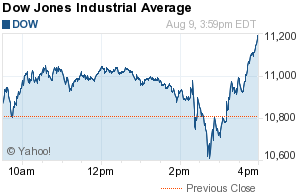
With all of the uncertainty and volatility in markets across the world right now, it's really hard to forecast or predict what's next. Looking at last year's pattern just won't cut it. It's hard to plan a big sale or predict results when constant change is the new norm. So what can you do? Here's a few pointers:

DJIA Results from August 9, 2011. From Yahoo! Finance.
1) Plan for disaster, but keep going. Schedule that grand opening. Have a sale. Send out some e-mails. Write that press release. Update your blog. Do a Facebook promotion. But understand that something as big as the debt ceiling debacle (and the super-fun it's caused) can happen anytime. Just because stuff happens, doesn't mean you stop doing business.

2) Redeploy underutilized assets. That's a fancy way of saying that if you have an eblast that no one read because all of your customers were paying attention to the shenanigans on Capitol Hill, tweak it a bit and send it out again. It'll save you time and design costs, and the message may take the second time around.

3) Be flexible and play out the what-ifs. What if your next sales event is hijacked by world events? Always have a Plan B. The best marketing plan is a flexible one. Be ready to reschedule, retrench, reboot, and restart. Think more carefully than usual when you order inventory and supplies. Don't order anything that can't be sold more than one way or any supplies that can't be repurposed.

4) Keep your head up. If you can get through now (and you got through the last thing), you can get through the next thing. Being resilient is key to survival. You can do it!

How are you getting through this crazy time? Please comment on this post.

Related posts:

Creating Your Marketing Plan
Four Ways to Keep Your Head Up in Tough Times

It's Monday. Three Ways to Drive Sales Today

It's Monday morning. You're still waiting for that coffee to kick in.

Meanwhile, you're reviewing last week's sales. And they're not where they need to be.

What can you do?
Coffee at my secret morning coffee placephoto © 2006 Pete Barr-Watson | more info (via: Wylio)

1. Beef up your customer loyalty program. 
What are you doing to thank your most loyal customers? Are there any sales you have going on right now that they might want to know about? Make sure that 1) you're thanking them, and 2) you're asking for a sale.

2. Push your most profitable product.
Which one of your products has the best margin right now? Shouldn't you be selling more of it? Put it in your stores' front windows, advertise it front and center on your web site, and promote it on your social media channels. The more you sell, the more efficiently you're making money.

3. Try a new channel.
Today is the day it's finally time to stop procrastinating and start your Facebook page. You can let fans know about your latest specials, events and promotions, and new products.

So, what are you waiting for?

Make Monday work for you. Need help? Ask me how.

Seven Ways to Beat the Creative Block

It's hard to get up every day and be 100% creative.

Sometimes I get up and I'm just not inspired. Here's what I do when I'm all out of great ideas.

1) Check my Twitter account. This is where I connect to other people who do what I do, so I can see what they are thinking about today. It's also a great source of overall news and interesting ideas.

2) Login to LinkedIn and see what my connections are doing. Is anyone working on anything interesting? Did anyone post anything thought-provoking in one of my groups? The answer to this is almost always yes.

*inspiration*photo © 2008 Cornelia Kopp | more info (via: Wylio)
3) LinkedIn has also recently launched a feature called LinkedIn Today, which displays headlines based on your chosen news sources and what's being shared by the most people. This is another great way to find out what people find relevant right now.

4) Checking google trends tells me what the most popular google searches are right now. While this usually just confirms for me that I'm way behind on my pop culture, it can be a great way to find out what's top of mind out there.

5) Sometimes I visit Wikipedia's main page. Wikipedia will tell you what happened on this day in history (which is always of interest), provide the latest news, and showcase a few other interesting things I didn't know.

6) It's usually worthwhile to take a 10-minute break to watch a TED talk. Some of the most inspiring people around are on TED and there's always the opportunity to learn something new.

7) If I'm still not inspired, maybe today's not a day for creative work. Maybe it's time to take a break and do something else. It really can help to just give myself permission not to be creative today. I can work on many other things - accounting, reporting, customer service, or other project work. Sometimes getting organized is all I need to get unblocked.

How do you cope when you feel blocked? I'd love to hear your thoughts.

Don't Rickroll Your Audience - Try this Instead

For those of you who haven't had the pleasure, getting rickrolled means that you've clicked on a link to content that interests you, only to get Rick Astley's "Never Gonna Give You Up" video.

Why am I talking about this now? Rickrolling is so 2008.

Because thousands of businesses rickroll potential customers every day.

How?

Rick Astley.
Flickr user chinnian
1.  Say you really need to move some polka-dot sweaters this week, so you advertise a great deal on them. Unfortunately, you send users to your home page, where the sweaters aren't promoted. Users have to use your menus to get to apparel, then women's, then sweaters, then polka-dot. Congratulations, you've just annoyed the crap out of your customers, and most have given up.

Don't rickroll - link directly to your deal!

2. Say you've just discovered that your product, baby powder, repels ants like nothing you've ever seen. So you do some promotions targeted to people interested in beating their ant problem. Unfortunately, you send these folks to your regular baby powder page, which is all about beating diaper rash. Is this the same stuff that makes ants go away? Your customers don't know. They leave empty-handed, feeling confused.

Don't rickroll - match your audience to your content with tailored landing pages.

3. Say you've created a great new diet solution. You place an online ad that says "Avoid these five foods, and lose weight today!" Lots of people click on this ad, but these five dastardly foods are nowhere to be seen. Instead, there's a video of indeterminate length (Are the five foods in there? Do I have time to watch this now?) and a exhortation to join your paid diet plan web site.

Don't rickroll - provide the content you've promised and people will want more.

Need help matching your deals, your content, and your audience? Let me know.

Three Things you can do Today to Drive Sales

It's Monday morning.

You're tired. That second cup of coffee hasn't quite kicked in yet.

You're looking at last week's numbers, and they aren't good. You need to do something today to get those numbers up.

So now what?

Elvis Presleyphoto © 2009 Cliff | more info (via: Wylio)
Should you put a guy on the street with one of those big arrow signs leading to your store? Hire an Elvis impersonator? Get some of those car show models?

All of those are creative ideas, but here are three ideas that will really get things going:

1. Identify a small group of loyal customers.

Create a sale just for them. Call or e-mail them and say thank you. Extend this offer to them. It doesn't have to be much. You can even use a discount you're already doing. What's important is 1) you're thanking them, and 2) you're asking for a sale.

2. Identify the product or service that's selling best right now.

Send our an e-blast promoting that product. If you've got brick-and-mortar locations, put it in the front window. If you're a service, rather than product, business, put that service front-and-center on your web page, your blog, your twitter feed, your LinkedIn page, and anyplace else you can think of.

3. If you have a Facebook page, do a Facebook-only sale.

This is another great way to thank your fans. It also provides value to people for being your Facebook fan. Third, it's a great way to get more fans on Facebook - be sure to put a note on your e-blast and your web site that says "Follow us on Facebook for Facebook only sales." If you don't have a Facebook page, and you're a business-to-consumer (B-to-C) operation, consider starting one today.

So, what are you waiting for?

Get started driving sales now and start your week off right. Need help? Let me know.

Secret Trade Secrets on Defining Your Audience

So who's buying your product anyway?

The more you know about your customers, the better you can serve them and develop new products and services that fit their lives.

Who the heck are these people?

What kind of people visit your retail stores, purchase from your print catalogs, buy on your web site, or on their mobile phones?

How are marketers targeting people by income, age, house value, hobbies, magazine subscriptions, etc., etc., etc?


Let me tell you about the data overlay.


Floppy-Disk-1.44-Mb_FujiFilm-MF2HD_82374-480x360photo © 2010 Emilian Robert Vicol | more info (via: Wylio)

That's right. If you want to spend a little money (there's usually a fee per thousand records) and you have valid street addresses on your customer file, you can buy hundreds (even thousands) of data points on your customers. What kind of cars do they drive? How many children do they have? What type of home do they live in? How educated are they?


Understanding some key data points about your customers will help you to group them into buying segments.

Having all of this data enables you to profile people who behave in a certain way. Maybe most of your catalog customers are married men over the age of 55, and most of your mobile customers are single women aged 18 - 27. Perhaps the people who spend the most money with you per order are married female online customers aged 30 - 45 with a household income of $60,000 per year or more and a college education. Perhaps gardening hobbyists are attracted to your brand.

There are lots and lots of data points. What should you buy?
I recommend the following for most products:
Age
Gender
Household Income
Net Worth
Education
Presence of Children
Ages of Children

Then, it depends. If you're selling housewares, you'll want to know what types of homes people live in. After all, you don't want to send your outdoor furniture catalog to people who live in apartments. If you're selling pet-related products, then you'll want to buy data on pet ownership. Ditto for cars. If your product is related to a specific hobby (say gardening or travel), then you'll want to make sure you get your records flagged for customers with those interests.


How does it help?
Knowing more about your customers' basic demographic makeup helps you to craft products and messages that are tailored to their stage of life. It also helps you create groups of customer clones. In the example above, I mentioned that your most profitable customers might be educated, high-income, married females age 30 -45. Since you know that this type of person has potential to be extremely profitable for you, now you can start looking for places to find more people like this. By cultivating people who are a lot like your best customers, you're raising your chances of getting more good customers.


Where does this data come from?
There are several organizations that collect this data, most notably the three major credit agencies. They get it from warranty cards, survey responses, loan/purchasing behavior, and a number of other sources. If this gives you the heebie-jeebies, you can contact the Direct Marketing Association or sign up for OptOutPreScreen to protect your privacy.

Now what?
You can contact any one of several vendors who provide data overlay services, or contact me and I'll help you get started.

Sometimes, the Best Answer is "More!"

My neighbor recently wrote and published a book about better leadership for people in charge of Boy Scout Troops. He's sold half his first print run (hooray!), but he still has half to go. He asked me for some marketing advice. Here's what I asked him...

seeing_pi_chartphoto © 2010 Jorel Pi | more info (via: Wylio)

Where is your book for sale?
It's selling on Amazon and he's set up a web site where folks can buy it too. So far, so good.

Is it visible to search engines?
Yes - it's one of the top few results if people search on "scout leadership." Even better.

How are you promoting it?
On his Facebook profile, which is also good. I suggested he look into a Facebook ad. He can set up the ad to target people who have "Boy Scouts" as an interest, and target by age range and geography if he wants, too.

What about the press?
He's been interviewed about the book, and the person who interviewed him recorded it as a podcast, which is fantastic. In fact, many of his sales are coming from people who listened to the podcast.

This is key.
We now know a that a primary motivator for sales is this podcast, so we need to find ways to get this content to more people. He's got a link to it on his web site. I suggested he add it to Facebook too, and ask others to link to it, which brings me to my next point....

What about the blogosphere?
There are blogs about everything, including Boy Scout leadership. My neighbor has had some positive reviews from bloggers, which is also great. He needs to reach out to more of them and ask them to review his book and link to the podcast. I also advised him to offer to guest blog for these folks - bloggers are always looking for content and a guest blogger can provide a blocked or busy writer with a much-needed break.

So, what's the lesson here?
My neighbor has been doing a great job marketing his book through multiple channels, and to sell the second half of his print run, he needs to just do more of the same - more interviews, more blogs, more links. My advice to him - just do more.

What about you?
Which of your marketing channels seems to bring in the most sales? Is most of your sales traffic from a radio ad? A coupon? Your blog? Your Facebook page? Whatever channel leads to the most sales is the one you want to try and drive more traffic to.

Not so sure what's working or how to measure it? I can help. Drop me a line.

Marketing News Roundup - April 29, 2011

What's new in marketing this week?

Is there a group buying bubble? Huddlebuy, another new group buying site, this time for small businesses, launches in the UK. 

Speaking of bubble, don't forget Facebook, which launched Facebook Deals in Atlanta, Austin, Dallas, San Diego, and San Francisco this week. 

Fingers tired? German site slashtag.it is ultimate search shortcut. (FastCompany)

Musical comedy star Dorothy Brunton reading Sid Nicholl's Fashion-plate Fanny in the children's section of The Sun newspaper with a small boy at St. Margaret's Hospital, Sydney, January 1925 / Sam Hoodphoto © 2009 State Library of New South Wales | more info (via: Wylio)

In data security news, Sony's PlayStation network was breached, possibly including credit card data, prompting a class action lawsuit alleging that Sony was negligent in protecting customer data. (USA Today GameHunters blog)

In response to customer fears that Apple is tracking iPhones (and their users) everywhere they go without consent, Apple now claims that it doesn’t track the physical locations of iPhones - only the wi-fi hotspots and cell towers to which these devices connect. Would have been nice if they just told people that in the first place. Two customers in Florida are suing Apple anyway. (The Escapist)

And finally, this is kind of obscure, but I thought readers might want to know that Prince William of England married a woman named Kate Middleton today. Maybe they will post a video on YouTube, in case anyone would like to watch the Royal Wedding.

Have a great weekend, and thanks for reading!

Setting Your Price Without Screwing Yourself

How much should you charge?

This is a hugely important question. How much you charge for your product or service affects everything - how much you profit, how much you're able to pay your employees and vendors, how much you can spend on supplies, marketing, and everything else.

So how do you decide?

First, it's time for some competitive analysis. Once you determine who your major competitors are, do a thorough check of all of their pricing. What do they charge online? Is it different if you call or go into a store?

What does their pricing really include? What should your pricing include?

Tons of moneyphoto © 2008 Paul Falardeau | more info (via: Wylio)


Some of your competitors probably charge a little more and include some extras. Some charge a little less and use a more a-la-carte plan. These extras should make for happier customers with more loyalty to your brand. This is what's behind L.L. Bean's recent decision to include free shipping on every order. Watch out, though -  if you include too many extras, you can't stay in business.

By the same token, price yourself too cheap, and you just can't generate the cashflow to stay solvent (like former apparel retailer Steve and  Barry's).

So now what?

Say you do  decide to go the L.L. Bean route and include free shipping on every order. Can you really do this? If you're not sure, ask your financial analyst (or hire a financial analyst - it's worth it) to do a full rundown on how much including shipping in every order would really cost you. If you find you can't afford to include shipping on every order, are there certain orders where it's better to include free shipping?

Like maybe for first-time customers, or customers referred by other customers? Or your most loyal customers? Or customers who spend a certain amount? Or even customers ordering your clearance items?

You can do (or have someone do) a financial analysis on each of these scenarios, according to your current order pattern. Then, you'll see what each might cost you.

What about pricing on everything else?

Run the numbers. What can you afford to charge? You'll want to leave room in your regular pricing for a sale, should you need to discount items later to move them. If you're charging far more or far less than the average price, you should have a good idea as to why. Is your product better than others like it and that's why it costs more? Is it handmade? Made in the USA? Environmentally friendly?

When you charge less, customers want to know what that is too.

Oh yes they do. I promise. So why are you charging less? Do you negotiate the best prices from your suppliers? Use super-efficient manufacturing methods? Buy from a variety of vendors so you're always getting the best price? Concentrate on really low overhead?

Finally, always be willing to change.

If your current pricing strategy isn't working, change it. You might find you're not charging enough for some things and too much for others. Keep analyzing and testing until you get to where it works.

Does the thought of a pricing strategy give you the shakes? Let me know, I can help.

Three Ways to Find Out what Your Customers Want

Actually, the best way to find out what your customers want is to simply ask them.

That's right - just ask them. Stop hiding behind generic e-mail addresses,  automated receptionists, and your PO Box.

Get out there! Here's three easy ways to get customer feedback now.

Click to rate this clock from
Uncommon Goods.
http://tinyurl.com/3ny2feo
Try a little Twitter. Twitter is a great way to ask questions. Red or blue? Cherry or grape? This one or that one? Your followers will provide instant feedback.

Put your face on Facebook.  Facebook is one of the most efficient and cost-effective ways to connect with your customers, especially if you're a consumer brand. You can easily post surveys, questions, videos, links, and anything you want customers to see and comment on. If your customers are other businesses, you can do the same on LinkedIn.

Make your e-blasts interactive. Do you send a weekly or monthly email blast to your customer list? You probably tell them all about your new products and your latest sales. Here's another opportunity to ask them what they want - can they vote on what products you carry? Rate your newest items? Recommend something you should sell?

Who's doing this now?

If you want to see this in action, there are two brands who really excel in this space (not the only ones, just the first ones I thought of). The first is retro indie brand ModCloth, with their Be the Buyer program, and the other is green artisan brand Uncommon Goods, where you can simply vote on product to similar effect.

How do you get customer feedback and engagement? Share in the comments. 

Need help? Let me know.

Profiting from Off-Label Uses for Your Product

Are there off-label uses for your products?
You know, like the use of hormone injections for weight loss or coffee to relieve headaches?

Now is a great time to think about other ways your own customers might be using your product.

Tito has some great alternative uses for your extra tuna.
Photo: J. Ibraheem
Do your socks make great potholders?

Are people reheating their leftover pizza with your waffle irons?

Are they using your spreadsheet software to plan their weddings?

Or using your kitty litter to prevent odors in the fridge?

There are huge opportunities to sell, keep, save, and serve your customers if you can figure out other purposes for your products:

Sell – people might not need your product for its primary use, but they badly need a solution for one of its alternative uses. Are you letting them know about other uses in your promotions?

Keep and Save – your current customers might no longer have the problem your product was originally meant to solve. No worries- they can still use it. Just make sure to let them know how.

Serve – Customers who love your product for its original use will be delighted to find out it’s so versatile. Make sure to let them know how useful it is!

Not sure how your product is being used by your customers?

Ask them! On your blog, your Facebook page, your Twitter feed, in your stores, in your e-blasts, on your web site. Your customers are your best source of information. Ask them all kinds of questions, and ask frequently!
Not sure if your product can protect your hands, reheat pizza, prevent fridge odors, or help with wedding plans? Send me a note and I’ll be happy to help.

How are people using your product off-label? Please share.

A Tale of Two Credit Cards - Why Customer Service is Marketing, Too

These guys were totally frightened by my credit card rates.
Photo: Leah Ibraheem
I have two credit cards - one I use several times a year for making travel arrangements, and a second one that's a backup.

Earlier tonight, I called my main credit card company to ask them to lower my rate. I'd read a number of scripts for this conversation and planned to tell them all about how I had received better offers from other companies, that my rate was too high, that I have excellent credit, and they should help me out.

The first person I talked to said that I already had the best rate and that she would not be making any changes. I said, "I guess you'll just need to cancel my card, then."

I'd read in all the scripts that you should do that.

She said, "OK."

Wow.

So I was transferred to a supervisor and she couldn't lower my rate either. After several minutes of negotiations, she offered me two months of interest payments back, which was nice. I was not happy that they wouldn't lower my rate, but this was better than nothing. Feeling empowered, I called my other credit card company, which happens to be Discover.

The woman at Discover was the nicest woman ever. She even told me where she was located (Portland, Oregon) and thanked me for my eleven-year, six-month relationship with Discover. She asked me how she could help, and was interested and enthusiastic.

Well, let me tell you this -

Not only had Discover recently evaluated my situation and taken the initiative to lower my existing rate by five points (which I didn't know since this happened after my last statement), they readily agreed to offer me a 6-month promotional rate that was another eight (eight!) points lower than the new rate they'd already extended to me. That's 13 points!

After that, my customer service rep let me know about some additional discounts I could get for travel and a special cash-back bonus on home improvement items that begins this month. She never rushed me and she kept thinking of more and more ways she could help me.

Her goal: to make sure that my Discover card was my primary card, which it hasn't been - I hardly ever use it.

But that's about to change. Why? Because Discover's marketing, sales, and customer service are integrated to effectively save, keep, sell, and serve me, all at the same time. How does that work?
  • They were actually working proactively to save me by assessing my account and lowering my rate before I even called.
  • They were ready to keep me with an additional offer to make their card even more of a value.
  • They had several product suggestions ready to sell me - products that would save me further on things I'm already buying, deals which are useful to me specifically.
  • They emphasized how much they wanted to serve me by identifying the length of our relationship, thanking me for it, and offering numerous ways to help.
What can we learn from this?

Maybe it's time to take another look at your customer service operation - does it work to save, keep, sell, and serve your customers? How can your marketing department help your customer service reps with the right things to say, great offers, and the power to use tools like special promotions, savings clubs, and new products to keep your customers happy?

I'd love to hear about what you're doing to save, keep, sell, and serve. Please tell me in the comments, or send me a note.

So, which credit card just moved from my desk drawer to my wallet? Three guesses, and the first two don't count.

How to Start Your Competitive Analysis

I promised you last week that I'd write a post about doing competitive analysis, so that we could answer three very important questions.

  1. Where are you in the competitive space?
  2. Who are the other players and what do they offer right now?
  3. How are they getting the word out?
Today, I'm going to tackle the second question only. This is usually the most practical place to start. After all, you can't answer the other two questions until you know the answer to this one. A few thoughts on this:

  • Don't forget that your customer always has the option not to buy whatever it is you're marketing. This is actually your first, and your largest competitor. You'll have to overcome your customer's resistance to spending money, eating dessert, going shoe-shopping, getting a manicure, etc., etc. Don't worry, I'll cover this in a future post.
  • Next it's time to look at where people are buying products similar to yours, as well as products that are different than yours, but solve the same problem. For example, if you sell pies, don't just look to other piemakers. Check out cake bakeries, and any other place people might get dessert - ice cream shops, cupcake trucks, regular restaurants, and the grocery store.
  • Look carefully at product offerings by the competitors you've identifed. What's different about your pie? How does it solve the problem of what to eat for dessert better than other pies? What other problems can be solved with pie? Are there better ingredients? Is it handmade? Is it a great value? Is it customizable? Is it more convenient? Also, why is pie a better choice for dessert than cake, ice cream, or anything else?
These are thoughts to get you started as you begin your own competitive analysis. If you have any questions, please let me know.