Pages

Showing posts with label data-driven marketing. Show all posts

A Neat Idea for Leveraging Your Facebook Fan Base

Facebook is good for a lot of things, but one of my favorite things about it is that it makes your birthday really, really fun. Even people who rarely use Facebook visit their pages on their birthdays - after all, who doesn't want to check out birthday greetings from friends around the world?

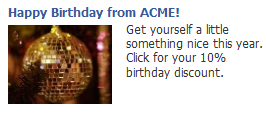
Facebook birthday ad
You can use this natural inclination for birthday greetings to help your business. Did you know that you can target Facebook ads to people with a birthday in the next week? This is a time when people are already checking their Facebook pages to see all the postings from their friends, so make the most of it.

When you're creating your ad, at  "Choose Your Audience," next to "Broad Categories," pick "Events," and then "Has a birthday in less than 1 week."

Target ads to Facebook users with Birthdays


At this point, you're positioned to deliver some very targeted, relevant ads. You can deliver special offers with a message acknowledging your customers' special event.

Messages like: 

  • Happy Birthday! Get yourself a little something nice this year. Click for your 10% birthday discount.
  • It’s your birthday. We have a present for you – 10% off for your special day!
  • Happy Birthday! Click to learn more about your special birthday deals.
As you can see, these ads reach your audience in a meaningful way. I'd encourage anyone to test a birthday offer on Facebook against any other ads. The results may surprise you.


How are you using customer data to deliver more engaging, relevant offers? Please share.


Related Posts
Five Steps to a Better Facebook Feed
Using Facebook to Drive Retail Traffic

How to See the Opportunity in Your Own Email Files

A lot of non-profits (and businesses, too) that I work with have a similar problem - email lists all over the place, in different formats, with different permissions. If this sounds like you, it's critical to your future success that you do something about this ASAP. Why?

Clean Up Your Email Lists and See Better Results.
Lists. From Flickr user James West.
Your best source of new subscribers for your different email campaigns is sitting right in front of you. Think about:


1) Cross-promotion! Once you have your list all in one place and de-duped, you'll have remarkable opportunities to cross-promote your various initiatives. The people on your different lists already like your brand and are more likely to respond than people who haven't ever subscribed.

2) Re-activation! People who subscribed to a campaign you ran a couple of years ago are far more likely to be interested in your current activities than people who've never subscribed before. Here's your chance to reactivate them and opt them in to a more general list.

3) Information! Find out who your most active subscribers are. Don't you want to know how many people are subscribed to multiple lists, and to which ones? If you see that there are some common trends, it might be time to further consolidate your messaging strategy. You'll also find that some of your buyers from one list are prospects on another list. Shouldn't you be giving them loyal customer love whenever you talk to them? (Yes.)


These things are really, really important, which is why I've given them three big exclamation points.

Mine your own email list now, before you go out there and pay a whole bunch of money to get new subscribers. Once you're all set, THEN, you go get some more new subscribers.

How? Ask your shiny, buffed, nicely ordered list to recruit a few friends. The best businesses often  comes from referrals. You'll be able to do this in a targeted way, now that you better understand your customers' behavior.

How's your email program going and what do you wish was different? Do you need help consolidating lists? I've done it before, and I'll do it again (just let me find my spurs). Drop me a line and I'll be glad to help.

Related Posts


Why Testing Is Key

The Best Approach to Email Marketing

Why Testing is Key

A man I know who manages a high-end car dealership recently held an event for his top customers. To promote this event, he did three things:

Set up some tests to find out what approaches work best.
Testing helps you get results. Image from Dave Bleasdale.
1) Mailed a postcard that encouraged customers to call and RSVP.

2) Sent an email that encouraged customers to call and RSVP.

3) Sent an email that said "click here to RSVP."

Here's what happened:

1) 100 people responded to the post card.

2) 150 people responded to the first email.

3) 500 people responded to the second email.

4) 600 people attended the event, and about 50 of them decided they were ready to buy another car.

This was a great lesson for my associate in testing.

Until this point, he hadn't been a big believer in email, or in clicking on things, but this proved to him without a doubt that he had to make things easy for customers if he wanted results, and that an email with a one-click RSVP was far easier for customers than asking them to call.

Next time, he'll do the one-click email first, and follow up only with the people who don't RSVP with other methods. It'll be faster, cheaper, and more effective.

So what are your takeaways here?

  • Just because you've always done something a certain way doesn't mean that's the way you should do it this time.
  • You have to meet customers where they are. If everyone's on email, then that's where you need to be, no matter how much you'd rather they were on the phone, or on Facebook.
  • Testing often tells you things that challenge your assumptions, which is why you should do it. Don't assume that one approach will always work better because that's what conventional wisdom tells you. In this case, the business owner assumed a telephone call-to-action would work best because it had worked in the past, and because his high-end clientele liked a personal touch. It turned out that high-end customers still prioritized convenience over everything else.

What have you tested lately, and what were the results?

Need help setting up some tests? Let me know, I can help.

Related Posts

Email Isn't Dead! Make the Most of Your Email Program this Year

The Best Approach to Email Marketing


What You Need to Know About Basic Web Analytics

Web analytics sounds like rocket science, but it's not. You really should be looking at your web traffic on a regular basis  - it will help you better understand what's truly driving your business.

Web analytics can help you grow your web traffic
Image: Search Engine People Blog.
Which numbers are worth a look?

I always tell people to start with the basics:
  • Visits - how many different visits there have been to your site in a given period. A visit is a session on your web site, which might include multiple page views.
  • Visitors - a visitor is a person visiting your site. You'll want to check for new and repeat visitors, so that you can understand loyalty, and also understand how many visits it takes to convert a customer.
  • Average time on site - This is how long the average visit lasts. It's good to keep an eye on this - short visits could mean that people aren't engaging with your site the way you want them to.
  • Bounce Rate - this is the rate of site visits that only include one page. Bounce rates for blogs are typically high as people read that day's post and leave, but a high bounce rate on an e-commerce site means that people are leaving your site without buying. If this is the case, you need to figure out why. Are you, for example, rickrolling people who come to your site from ads or email?
  • Pageviews - this is the total number of pages viewed on your site during a given timeframe. Ultimately, this isn't a very useful number - numbers like Visits and Visitors are more instructive as to your traffic. However, this is always the highest number in your stats, and I find it's the one that the people in the corner offices always want to hear about.
  • Traffic Sources - this is the most important data you have. This tells you how people are finding your site - through your email campaigns? Via Facebook? Through search? online ads? Further to this, once you connect traffic sources with conversions, you'll find out what's really working for you. For example, if you find that email isn't your biggest source of traffic, but it is the one responsible for the most conversions, then you know you need to concentrate your marketing efforts on building your email list - your customers may need to hear from you on email a few times before they are ready to buy.

How are you using analytics to drive your business? Let me know in the comments or contact me and I'll show you what to do.

List Acquisition 101 - Which List is Right for Your Business?

As business owners and marketers look to grow their businesses, one thing we all do is search for ways to grow our customer base. After all, a strong loyalty program does have limits. Even your most loyal customers have a natural limit to what they can buy.

List. Flickr user Ex-Smith.
Thus begins the search for new customers. You can find new customers in a lot of different ways – advertising, social marketing, word of mouth, and list acquisition.

List acquisition happens when you rent a list of people and market to them. Those that respond to your marketing become members of your own house file. The ones who don’t respond can’t be marketed to past the terms of your list rental agreement, which may be for single or multi-use.

As a general rule, you can rent lists of people two ways –by demographics or affiliation. You can even combine the two. Here’s how it works:  
  • By Demographics – you can choose the age, income, net worth gender, location, interests, and a number of lifestyle and buying habits. Do you want homeowners or renters? Parents or non-parents? People with pets?
  • By Affiliation – you can also choose from a wide range of memberships and magazine subscriptions. Do you want members of AARP? People who subscribe to Cat Fancy? Graduates of certain colleges? Members of teachers’ unions?
  • Both – Work with a reputable list broker and they will be able to provide you with, for example, Cat Fancy subscribers between the age of 25 – 45 who live on the Eastern Seaboard and make more than $40,000 a year.  

What’s the difference between mailing lists and email lists?

With mailing lists, for the most part, you’ll be able to bring the names into your database and use them for the rental period as you see fit, per the terms of your rental agreement. This gives you the opportunity to send a series of promotions. Anyone who responds remains on your list after the rental period is over, even if they don’t buy.

Email lists are, in general one-time or one-campaign use, and you don’t get to send the email from your desk – the list rental company or list owner does that – you provide the creative content. Again, anyone who responds and opts in joins your house file.  

What about those coupon sites?

I have posted on this blog before about my wariness of coupon sites– after all, we all have to deeply discount our product and the customers get more and more loyal to the coupon brand – Groupon, LivingSocial, or whichever - rather than our own brand.

HOWEVER, it’s worth investigating how much this might cost –the contract with the coupon site, your discount, costs of doing business, AGAINST the costs of a traditional email list rental campaign. After all, the coupon sites’ customers are loyal to that site and thus likely to open the email with your deal. Those who sign up for the deal become your customers. Depending on your business and your offer, you may garner more customers this way.

Do the math, before you do anything else. If numbers aren’t your thing, it’s worth paying your accountant for an hour of her time to show you what’s what.

How are you building your list? Please share in the comments.

Related Posts
Secret Trade Secrets to Defining Your Audience
Group Discount Sites - My Two Cents

Making the Most of Your Email Marketing in 2012

If you think email is over, you’re wrong. But this is a popular time of year for people to unsubscribe from email lists that aren’t providing any value, so why is email important and how can you make subscribers stay?
Photo from Flickr user Cambodia4kidsorg.

It’s totally customizable! You can tailor email messages to your customer’s latest purchase, stated interests, location, or age. Whatever data you have on your customers can be used to make messages hyper-relevant. The more relevant your message, the more your subscribers will appreciate it an stay on your list. Ever try customizing your tweets?

You can test and re-test! Testing subject lines, images, and PS text will help you understand what drives your audience. Test a small portion of your email list and then send the winners to your larger list, driving up your open, click-through, and action rates. Testing also provides you with a scientific basis for your marketing strategy. Strategic proposals that are proven winners are likely to get more support from your executives and investors.

It's economical! Unless you are paying sites like Groupon or LivingSocial to do your email marketing for you while you deeply discount your products, email marketing can be very cost-effective- much more so than doing large direct mail campaigns or major ad buys.

Email should be a key part of your multi-channel strategy for 2012. It can help you generate leads, qualify customers, predict which products will be winners, and drive repeat business.

Drop me a line if you'd like to talk email marketing strategy.

Your 2012 Strategy - Understanding Your Customer Data

Last week, I kicked off 2012 planning with a some notes on crafting your marketing framework around your overall business goals.
Data Disks. From Flickr user Emilian Robert Vicol.

This week, I want to have a bit of a chat with you about your customer data.

What do you know about your customers and how can you put that to use?

Here are a few basics to consider:

1) Geographic location - provide customers special deals based on the closest store location, on the season it is where they live, on the local sports team, or on common leisure activities in their part of the country. A strong local marketing strategy should be a key driver for your business.

2) Demographics - like age, income, net worth, and education - While lifestage is a stronger marketing metric, you can still tune the language and the imagery you use based on these kinds of metrics. Also, knowing the typical demographic of your customer is critical when you're considering where to advertise and how to price new products.

3) Purchasing behavior - this is really the strongest data you have. People's past behavior is the strongest indicator of future behavior. Important points to consider:


  • Frequency - how often each customer buys
  • Recency - when the most recent purchase was made
  • Method of purchase - at the store, online on a computer, or online via a tablet or other mobile device
  • Source of purchase - referred by another customer, responded to your catalog, clicked on an email, web search, responded to an ad, or direct visit to your web site
Once you understand purchasing behavior, you'll be able to group your customers by behavior and market accordingly - sending emails more often to email customers, turning up ads from places where customers are responding, and tuning your search marketing based on the keywords that are working for you.

Data is your most powerful marketing tool. If you're not using it, you're marketing with the lights off.

Need to turn off the dark? Let me know, I can help you make the most out of your data.


How to Find Better Customers

The last couple of years have been hard on retailers. Customers expect sale after sale, more and more discounts, incredible service, and tons of freebies. And loyalty? Forget it. There's always another deal around the corner.

Photo: Flickr user Zizzybaloobah.
So how do you find better customers?

Reward the behaviors you want, and discourage the ones you don't.

First, examine your best customers.

How profitable are they? What are they buying? Are they on your email list? Do they follow you on Twitter? Are they your fans on Facebook? What's converting them to buy, and buy again?

In the process of this examination, you might find that your best customers are frequent responders to your Facebook promotions. That's great, but how can you use this knowledge?

Second, reward the behaviors you want.

If Facebook is your most profitable channel, then make your promotions even more profitable by crafting deals with the greatest possible margins.

Encourage customers on all channels to join you on Facebook as well. If your Facebook promotions are generating the most profitable customers, the more fans you have, the better.

Third, discourage the behaviors you don't want.

Which customers are the most expensive to serve? How can you redirect them to more profitable channels? If you find, for example, that customers who call your call center are the least profitable, consider adding more ways in which to serve them, perhaps encouraging them to use instant messaging, online resources (your FAQ are comprehensive, right?) or Twitter to ask questions.

Re-examine your shopping cart - is it too difficult to buy online? If you have a two-screen process, can you get it down to one screen? Can you highlight the safety and security of your shopping cart process?

At the same time, make sure your customers still have several options for both sales and service- your stores, call center, web site, and email. You don't want to turn people off unless you're absolutely sure you don't want their business.

What are you doing to reward your best customers? Please share in the comments.

Age vs Stage - What's More Important?

You probably know that you have different types of customers, and that it makes sense to group them somehow. After all, segmenting your customers makes your marketing more efficient - you'll be able to customize your campaigns to work most efficiently for each group.

So what's more important, customer age or customer stage?
Steps to sculpturesphoto © 2010 Vivian Evans | more info (via: Wylio)

Well, customer age can be a useful measurement - after all, you're going to pitch your messaging differently if most of your customers are over 65 than if most of them are under 21. It's also great to know your customers' birthdays so you can send them special promotions.

But wouldn't it be more practical to know if, for example, your 35-year-old customer is...

...a new parent?
...a full-time college student?
...a newlywed?
...just started a new job?
...taking care of an elderly parent?
...CEO of a large company?
...recently retired?

Wouldn't it be much more useful to know this information, rather than the age of your customer?

This is why lifestage is so important. Understanding where your customers are right now will help you craft offerings that resonate far better than anything else you might try simply based on customer age.

So how you do you find out what lifestage people are in?

The best way is by far the simplest- just ask.

Are you in the stage of life where you need some marketing help? Let me know.

Related posts:
Email isn't Dead! Permission Based Marketing Works
Secret Trade Secrets on Defining Your Audience

Email Isn't Dead! Permission Based Marketing Works

Lately, lots of marketers have been refocusing on email marketing as a way to better sell, keep, serve, and save customers. Though proponents of social media have declared email dead, businesses like Groupon, LivingSocial, and SniqueAway have proved them wrong. So why does email do wonders where other channels can fail?

It's all about permission-based marketing.

That's right. While all channels can be (and should be) permission-based, e-mail is by far the easiest to optimize this way and generates the best results.

How does this work?
Email email emailphoto © 2010 Keith Ramsey | more info (via: Wylio)

On a basic level, you should only be sending your email blasts to people who've agreed to receive them.

But it goes deeper than that.

If you sell more than one type of product, don't you want to know which of your customers are most interested? If you sell products for babies, why do you want to promote these to people without babies? Why do you want to sell garden supplies to people who don't have gardens? Why do you want to sell windshield wipers to people without cars?

You don't. (No, you really don't.)

This is where permission-based marketing comes in. Here's how it works:

Ask your customers which kinds of messages they want from you - what are they interested in and what do you they want to hear about? You can work with your e-mail vendor on this, or you can use one of several online survey tools to ask them. Then, simply send them what they want.

Why is this good?
  • It helps you determine the level of interest for each of your product categories.
  • You're of more value to your customers because you're only delivering content of interest.
  • You're respecting your customer by letting them hear from you only as often or as rarely as they want.
  • When you launch a new product, you'll have a much better idea of how many people will want it.
 Need help figuring out who wants what, where and when? Let me know.

Group Discount Sites- My Two Cents

Unless you've been doing your marketing under a rock lately, you've heard all about the exponential growth of group discounting sites like LivingSocial, Groupon, Facebook Deals, Google Offers. Now Amazon, AT&T, and your credit cards are getting in on the action, too.

The idea is that if enough people join a deal, the customers get a discount, and the merchant gets enough new customers to make it worthwhile, and the discount site gets a cut. Everyone wins!

But does it really work that way?

Not always.

Dollar Bill Snailphoto © 2008 Benjamin Reed | more info (via: Wylio) But doesn't this kind of thing generate customer loyalty? I'll get lots of new customers who return to my business, right?

Actually, the loyalty these discounts generate is to the discount site. That's right - LivingSocial is generating loyal LivingSocial customers, not customers loyal to your business.

But the good news is that you'll get a list of customers who purchased your deal, and now that they are your customers, you can continue to market to them and entice them to return to try your other products.

Isn't it going to be super-profitable for my business to get tons and tons of new customers?

Actually, this is heavily dependent on the nature of your product, the cost of serving your customers, and which deal site you choose - they all work differently. Carefully evaluate how much this will cost you and how much you will have to pay for this exposure. Make sure you understand exactly how many customers will see your deal. Some businesses create special products or services just for the deal sites - things that are less expensive to provide to customers so they don't take such a bite out of profits.

But the good news is that the deal sites are always looking for new businesses (and types of businesses) to try, and they are happy to talk to you about what kind of arrangement might work best. Don't be discouraged if you aren't a restaurant or salon- I've seen deal offers recently for solar panels, scuba lessons, and museum passes.

I can just post my deal on any deal site and it will bring in tons of qualified new customers, right?

Actually, no. Not all deal sites work alike and not all cater to the same clientele. Before you begin this odyssey, be sure you have an understanding of who your customers are and which customer segments you'd like to attract with your deal.

But the good news is that you can scrutinize the different sites to see which would be the best fit for you and your business. You can ask as many questions as you want about who the customers are, what they buy, and at what price.

Am I a total dork if I don't participate in the group buying party?

Actually, no. If you research the issue and determine that it won't be profitable for you, don't do it.

The good news is you can always try it later, if it makes sense another time.

Need help navigating this deal-crazy landscape? Let me know.
Secret Trade Secrets on Defining Your Audience

So who's buying your product anyway?

The more you know about your customers, the better you can serve them and develop new products and services that fit their lives.

Who the heck are these people?

What kind of people visit your retail stores, purchase from your print catalogs, buy on your web site, or on their mobile phones?

How are marketers targeting people by income, age, house value, hobbies, magazine subscriptions, etc., etc., etc?


Let me tell you about the data overlay.


Floppy-Disk-1.44-Mb_FujiFilm-MF2HD_82374-480x360photo © 2010 Emilian Robert Vicol | more info (via: Wylio)

That's right. If you want to spend a little money (there's usually a fee per thousand records) and you have valid street addresses on your customer file, you can buy hundreds (even thousands) of data points on your customers. What kind of cars do they drive? How many children do they have? What type of home do they live in? How educated are they?


Understanding some key data points about your customers will help you to group them into buying segments.

Having all of this data enables you to profile people who behave in a certain way. Maybe most of your catalog customers are married men over the age of 55, and most of your mobile customers are single women aged 18 - 27. Perhaps the people who spend the most money with you per order are married female online customers aged 30 - 45 with a household income of $60,000 per year or more and a college education. Perhaps gardening hobbyists are attracted to your brand.

There are lots and lots of data points. What should you buy?
I recommend the following for most products:
Age
Gender
Household Income
Net Worth
Education
Presence of Children
Ages of Children

Then, it depends. If you're selling housewares, you'll want to know what types of homes people live in. After all, you don't want to send your outdoor furniture catalog to people who live in apartments. If you're selling pet-related products, then you'll want to buy data on pet ownership. Ditto for cars. If your product is related to a specific hobby (say gardening or travel), then you'll want to make sure you get your records flagged for customers with those interests.


How does it help?
Knowing more about your customers' basic demographic makeup helps you to craft products and messages that are tailored to their stage of life. It also helps you create groups of customer clones. In the example above, I mentioned that your most profitable customers might be educated, high-income, married females age 30 -45. Since you know that this type of person has potential to be extremely profitable for you, now you can start looking for places to find more people like this. By cultivating people who are a lot like your best customers, you're raising your chances of getting more good customers.


Where does this data come from?
There are several organizations that collect this data, most notably the three major credit agencies. They get it from warranty cards, survey responses, loan/purchasing behavior, and a number of other sources. If this gives you the heebie-jeebies, you can contact the Direct Marketing Association or sign up for OptOutPreScreen to protect your privacy.

Now what?
You can contact any one of several vendors who provide data overlay services, or contact me and I'll help you get started.