Pages

Showing posts with label social media. Show all posts

Are You Ready for Cyber Monday?

I hope you've got your online promotions planned for Cyber Monday, which is coming right up on Monday, November 26.

Target Christmas Sale
In 2011, consumers spent more than $1.25 billion online during the Monday after Thanksgiving, up 22% from the $1 billion they spent in 2010. What's more, average order value was also up almost three percent, to $198.26.

Want your share? 

Of course you do. Even if you're not quite prepared for Cyber Monday, there's still time to make the most of the opportunity. Here's how:

1) Make your deals simple and shareable. Your offers should be easy to understand, redeem, and share. People do a LOT of comparison shopping on Cyber Monday and you don't want your deals to get lost by being too complicated. Also, easy-to-share deals mean customers can get you other customers. Make sure there are share buttons on every page, and include an "I got a great deal" sharable message with your purchase confirmations so folks can tell their friends what they bought.

2) Tell them about it! Announce deals for Thanksgiving, Black Friday, the weekend, and Cyber Monday on all of your channels. Customers expect consistent experiences on email, social media, and your web site, so make sure everything's updated.

3) Don't forget about SEO. Make sure you're using keywords like "Cyber Monday," product terms, and deal-related messaging in your web copy, so that search engines can find your work.

4) Update your ads. If you're running online ads, update your creative to reflect your Cyber Monday offers. Outdated ads will confuse your customers.


5) Is your operational house in order? Do you have what you need to keep your inventory status current, ship out extra orders, deal with special requests, handle complaints, send out additional promotions, and update your web site? If not, now's the time to act.

Need help getting ready for your best Cyber Monday ever? Let me know - I can help.


Engagement: This is What Marketing Is Now

There's another layer to your marketing plans that's critical to your success. If you're not giving your customers the chance to share their experiences, rate your products, and ask friends for their feedback, you're missing out.

Customers need to engage with you before they buy.
Together. Flickr user Dev Null.
You see, most people don't just look at your advertising, your web site, or your catalogs anymore when they're ready to buy. They do online research, they check product reviews, and they ask their friends what they think. 

So if you're not helping them do that, you're preventing customers from completing today's sales cycle. Why would you do that? 

So, while you're getting ready for your holiday sales push, add a couple of things to your to-do list:

1) Product reviews: Product reviews enable your customers to share their thoughts with you, and give advice to one another - a key part of today's purchasing experience. Even poor reviews help you - they give you a chance to make it right for your customers and to improve your products and service.

2) Community: Is there a place online where your customers can congregate? Whether you run forums, a Facebook page, or a Pinterest presence, you need a place where people can share.

3) Sharing: One of my favorite local restaurants just ran a contest where users were asked to take a picture in the restaurant (of their friends, the food, the decor, etc.) using Instagram and then post it on their Facebook page. Hundreds of people participated and they got some great submissions, and wonderful images of their delicious dishes. Customers had a reason to return to their Facebook page again and again to see new photos and vote on their favorites.

4) Let Them In: People need a little more than ads or marketing copy to get them ready to make a purchase. Can you show your customers how your product fits in with their lives? Give them real stories from real people? Tell them a little bit about you and your staff? Explain what inspires you to do what you do? I highly recommend you make some videos to show customers a little bit more about who you are and what happens behind the scenes. Let customers in, and ask them to stay a while.

How are you engaging your customers? Please share.

Need a little help making some friends? Let me know. I can help.

Related Posts
What is Story Marketing and How Does it Work?
Make Your Content Go Viral

Have You Tried a Facebook Promoted Post?


Recently, Facebook has been offering a new, inexpensive way to advertise. I think you should give Facebook Promoted Posts a try. Here's how it works, and why you should test it for your page.


From Flickr user Sean MacEntee.
How it works:


For a little cash - usually, $5, $10, $20, or a little more, depending on how many Facebook fans you have, Facebook will make sure your post is seen by a larger percentage of your fans and their friends. Right now, if you have more than 400 fans on your page, you can promote any post for three days.

Why you should try it:

An average Facebook post will be seen by about 16% of your fans. One of my clients is doing better than that - their average post is seen by about 30% of their fans. They have a small, but very engaged community.

When we spent $10 to promote a Facebook post, we went far beyond that - our promoted post reached six times that many people - more than twice the amount of people than our total fan base. Many more people saw and shared our promoted post than usual.

What's more, we saw a doubling of engagement in the 10 days after our promoted post, gained some new fans, and we continue to see a 30% lift in engagement on Facebook, several weeks after the promoted post. 

What to promote:

I'd recommend testing something entertaining - a video, photo gallery, game, or something else fun. Inactive fans - those who haven't interacted with you in a while - are going to see this post and you want to give them a reason to rejoin your active fan base.

But Beware:

Yes, we only spent $10 and got some encouraging results. But those $10 posts add up. Make sure you're budgeting appropriately - you don't want to be spending money every few days to promote another post unless you're seeing good results. Your priority should be generating quality, engaging content to serve your social media audience - once you have great content, then work on promoting it. 

Let me know how this works for you. I'm looking forward to hearing your stories!

Does your Facebook strategy  need a bit of a facelift? Let me know. I can help. 

Related Posts

You say it's your birthday? One more way to leverage your Facebook presence.
Connecting Facebook and In-Store Marketing


A Neat Idea for Leveraging Your Facebook Fan Base

Facebook is good for a lot of things, but one of my favorite things about it is that it makes your birthday really, really fun. Even people who rarely use Facebook visit their pages on their birthdays - after all, who doesn't want to check out birthday greetings from friends around the world?

Facebook birthday ad
You can use this natural inclination for birthday greetings to help your business. Did you know that you can target Facebook ads to people with a birthday in the next week? This is a time when people are already checking their Facebook pages to see all the postings from their friends, so make the most of it.

When you're creating your ad, at  "Choose Your Audience," next to "Broad Categories," pick "Events," and then "Has a birthday in less than 1 week."

Target ads to Facebook users with Birthdays


At this point, you're positioned to deliver some very targeted, relevant ads. You can deliver special offers with a message acknowledging your customers' special event.

Messages like: 

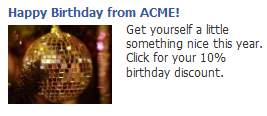
  • Happy Birthday! Get yourself a little something nice this year. Click for your 10% birthday discount.
  • It’s your birthday. We have a present for you – 10% off for your special day!
  • Happy Birthday! Click to learn more about your special birthday deals.
As you can see, these ads reach your audience in a meaningful way. I'd encourage anyone to test a birthday offer on Facebook against any other ads. The results may surprise you.


How are you using customer data to deliver more engaging, relevant offers? Please share.


Related Posts
Five Steps to a Better Facebook Feed
Using Facebook to Drive Retail Traffic

How to Feed the Social Media Content Beast

It can be really challenging to create, manage, and schedule content for your social feeds, especially if you work for a large organization where lots of people are responsible for delivering social media content, but few are actually held accountable for how often you post.

Feeding the social media content beast can be tricky
Social Media Beast. Photo: Doug Woods
Here's what I've learned about feeding the content beast:


Mine your email newsletters. If you work in an organization where several divisions publish their own email campaigns, you're in luck. This means each division is already identifying content that's important to them. All you need to do is convert their weekly headlines into social media posts.

Make a schedule. While it's always important that your social media schedule is flexible to accommodate breaking stories, it will give you important piece of mind to know that you have content available each day. Write multiple posts for each piece of content you promote so that you have some to save for later. We live in a 24 hour news cycle, but good stories are still relevant days, even weeks, after their original publish date. 

Repost and Retweet. Social media is a reciprocal environment. Identify partner organizations to your brand that you can share on your own social channels. Use Google Alerts to identify media clips and share those, too.

Share results. One of the best things you can do to motivate your organization to provide great content for social media is to show people what it does to support their goals. If you can explain how social media drives web traffic, sales, donations, or other support, you'll get more great content to share.

How are you feeding the content beast? Please share.

Related Posts

Why the Social Media Skeptics are Missing the Point
Twitter: Hey Morgan Stanley, You're Doing it Wrong

How to Raise Your Level of Social Media Engagement

...or, Social Media, You're Doing it Wrong

There are a lot of social media skeptics out there - people who say that networks like Facebook, Twitter, Google+, and Pinterest are a big waste of valuable time. Common curmudgeonly statements include:

Social media isn't just about cats, it's about engagement on many levels.
Gratuitous cat. Photo: L. Ibraheem
  • "It's all about kittens and what people ate for lunch"
  • "It's all women planning fairytale weddings and picking out nail polish."
  • "It's just young dudes playing video games and sharing some kind of code."
  • "My mom/grandpa/auntie uses it to get photos of the kids. "
  • "It's not for business."

I think they're missing the point. It's true that people do all of these things with social media, but

They do a lot more.


Like:

  • Sharing and supporting meaningful social causes.
  • Watching video how-to's
  • Inviting friends and family to send caring messages to a loved one with cancer.
  • Creating and sharing original art.
  • Getting in touch with experts about sticky business problems.
  • Finding jobs and employees.
  • Discussing the news of the day, and new developments in almost any field.
  • Learning about subjects that interest them.
  • Just keeping in touch with friends.
So, if you're finding that people aren't really engaging with you on social media,

Can you help them do any of the things I just listed above?

I bet you can. If you're not sure how, drop me a line. I can help.

Related Posts
What to do When they Won't Go Social
Removing Barriers to Social Media Success

Twitter: Hey Dominion Virginia Power, You're Doing It Right

Last week, I gave Morgan Stanley Smith Barney some pointers on using Twitter a wee bit more authentically.

This week, I'd like to extend some props to Dominion Virginia Power, which used Twitter in a highly effective manner to keep more than 900,000 customers informed who were affected by power outages which began as a result of a derecho storm on June 29th.

Since the outages began, the folks who are in charge of Dominion Virginia's Twitter feed have been Tweeting pretty much non-stop, and they've done a great job using these tactics:


  • Replying to pretty much every Tweet that's sent @DomVAPower. Their feed is full of @this and @that, and they do their best to answer every question.
  • Referring people to the right resource. Sometimes customers are directed to call and report an outage; other folks are referred to press releases, interactive maps, or web pages that show outage status. Dominion uses the resource that best matches the questions customers ask.
  • Partnering across the organization to get content out. Dominion is able to send customers to online resources that tell them what they need to know because the people who manage their web site are making those updates available non-stop, and the rest of Dominion's organization is working to get this information to their online team.
  • Keeping the right tone. Dominion celebrates when we're happy our lights are back on and sympathizes when it's 100 degrees out and we still don't have A/C. I didn't see any tweets where they became defensive, inappropriate, or unhelpful.
  • Being authentic and real. It's clear to me that real people run Dominion's Twitter feed and I appreciate them being available non-stop until everyone gets their power restored.
 
What's your takeaway?
  • For certain types of businesses, Twitter can be an effective customer service tool.
  • During an emergency, Twitter is a great way to let people know what's going on right now.
  • Since everyone can see your tweets, you can answer many customer questions by replying to one tweet.
  • Even though it took three days for Dominion to get power back on in my neighborhood, I still felt like they were doing their best. I knew they were on top of the situation because I could see what they were doing any time I checked their Twitter feed. I felt like Dominion was paying attention to the situation and that I could connect to them if I needed to. 
  • Dominion uses its Twitter feed to show that it cares about its customers. Do you do that with your feed? How many of your tweets are broadcast news ("Check out our new...") and how many are conversations with customers? It might be time to tweak that ratio a bit.
What do you think about Twitter for crisis communications and customer service? Let me know in the comments.

Need help making your Twitter feed more nimble, authentic, and useful? Drop me a line. I can get you moving in the right direction.

Related Posts
Twitter: Morgan Stanley, You're Doing it Wrong
How to Write Great Tweets

Twitter: Hey Morgan Stanley, You're Doing it Wrong

Morgan Stanley Smith Barney financial advisors are taking to Twitter in order to meet their audience where they are, which is great news.

Unfortunately, so far, the tweets seem pretty scripted, like this one, for example:


It shows up on several different MSSB advisors' twitter feeds, but the advisors aren't retweeting each other or talking to each other about the issue - they are just all delivering the same tweet.

Now, I'm all for companies being responsible about social media and making sure that they're in charge of the message - after all, Morgan Stanley's going to look bad if its employees are drunk-tweeting at 3:00am from Tijuana.

That said, it seems like they could benefit from a little flexibility. Maybe they want to provide the content and the link, and let the advisors come up with their own tweets?

Some of the tweets seem a little too cheerleaderish, too, like this one:


I'm glad that MSSB has a strong diversity initiative, but this kind of "I'm proud...Way to go" tweet belongs on an official corporate feed. This is more a question of style than substance. What if the tweet said something like this?

  • Off to #MSSB HQ for #diversity committee work. So glad to be part of this initiative!

The tone is a little more casual, and the emotion is more genuine and personal. The more informal style also invites readers to respond. Folks might want to ask Ms. DeBellis what the committee is up to and how it operates, which is exactly what we want to happen on Twitter.

I also noticed this tweet, and some other tweets that were similar:


Again, the tone here is just too formal. This sounds scary! The whole point of Morgan Stanley being on Twitter is to make personal financial management more accessible. Mr. Ledyard could have tweeted something like this:


  • Are you a trustee for a foundation or endowment? There are some guidelines you should understand. Let me know if you have questions.  

The more informal tone makes Ledyard more approachable, so people are more likely to tweet or message him if they want to know more.

So what's your takeaway here?

  • Make your Twitter style less formal than your press releases, whitepapers, and annual reports.
  • Share emotions - what are you excited about today?
  • Twitter is a place to talk to other people; keep that in mind when you write your tweets.
  • If you have several feeds to represent one brand, make sure feed owners are able to customize their tweets to their own voices so you're not repeating the same tweet many times.
  • Make sure your Tweeps are actually tweeting. Some of MSSB's feeds haven't been used in weeks.

What do you think of Morgan Stanley's approach? What keeps you from being more active on Twitter? Please share in the comments.

Related Posts

How to Use Twitter for Listening
Do You Need More than One Twitter

What Time Should You Tweet?

Recently, a colleague of mine asked me for my thoughts on the timing of social media posts. She has some clients that are just getting started on Facebook and Twitter, and they wanted advice on when to post.

The only rules about timing your social media posts are that there really aren't any rules. Every audience is different and each social network is different.

Use testing to figure out when to post to your social networks.
Photo: Flickr user Katerha.
I recommended she help her clients set up a tool like HootSuite so that they could schedule posts ahead of time, and then see engagement stats for posts sent at different times - morning, afternoon, evening, nights, and weekends.

One of her clients is a school, and they may find that many parents are checking for school news late in the evening - making sure they know the schedule for the next day before bed, or just taking advantage of the hours after their children are asleep. In the case of inclement weather, they'll be up early to find out if classes are cancelled.

I always recommend that organizations test posting on the weekend to see how it does. Lots of people do tend to spend time on social networks on Saturday mornings, while they are at the kids' soccer practice or just relaxing at home.

As a general rule, Twitter seems to be active later in the day, but what's really important is what the best time is for your audience - no one formula works for every organization.

Again, the best thing to do is test - try tweeting or posting on Facebook with similar content at different times of day and see what happens. The most important thing you can do is to keep testing - what times, and how often to post.

One of the best webinars I've seen on timing is from Hubspot, and it's called The Science of Timing. It's a couple of years old, but I find that it's still pretty relevant.

What time do you post and what times of day do you find work best for you? Please share.

Related Posts

Do You Need a Second Twitter Account?
How to Write Great Tweets

How to Use Twitter for Listening

In my social media travels, I've run into a lot of people who've given up on Twitter. Maybe they don't have time to write a lot of tweets, or they don't have many fans, or they just aren't sure the channel works for them.

Twitter is a great tool for listening to conversations
Twitter is great for listening. Photo: s1ng0
This tends to be especially true for some smaller non-profits. Budgets are small, staff is small, and there's just not a lot of time to devote to anything that's not achieving immediate results.

I tell these kinds of organizations that they are missing out on a huge opportunity to listen. Twitter is an excellent tool for listening, and for connecting to and influencing larger dialogue.

I advise these clients to use Twitter to follow others who do what they do, and to follow the discussion about the issues their organizations address.

For instance, the director a non-profit health clinic might use Twitter to follow other clinic directors and to monitor discussion of #Medicare, #ACA (the Affordable Care Act), #antibiotics, or #healthcare. This is a great way to locate current news and thoughts about these issues, and to contribute to a discussion involving people who are passionate and motivated to act.

Twitter's also a great way for busy professionals, like our non-profit health clinic director, to stay connected to others in her industry even though she can't get out to networking events or conferences as often as she'd like. Using Twitter, she can connect to others in her field and reach out for advice, input, and ideas.

Our clinic director can set up a HootSuite account in a few minutes, and follow those keywords that make sense to her. She'll be able to set up streams for her keywords so she can see them right in HootSuite, track discussions, and schedule replies.

How are you using Twitter? Please let me know @practicalmktr.

Do You Need More Than One Twitter Account?

While many organizations wonder if they are ever going to have enough time to manage the social media channels they have now, there are some people out there wondering if they need to start another Twitter feed. There are actually some good reasons for doing this in certain cases, so let's review:

1) Is your brand big enough to have a lot of sub-brands- like Coke (Diet Coke, Sprite, Snapple, etc.)? You should consider a feed for each of your large projects or product lines.

2) Do you have really disparate areas of work? If you make baby blankets and industrial welding equipment, then you're going to need two feeds for your two different audiences.

3) Do you have disparate audiences for the same lines of work? If your work appeals to college students and CEOs for different reasons, you might want to tailor feeds for each group.

4) Do you spend a lot of time on Twitter keeping in touch with friends? Are you on it while you're out on the town on Saturday night, maybe after you've had a couple of beers? Are you known as a 3:00am tweeter?  Set up a new Twitter account for your professional life, and make your current feed private and accessible only to approved followers. Really, you'll thank me later.

So how do you manage this?

There are several apps out there for social media management. The free one I'm most familiar with is HootSuite - it's easy to use and the free functionality does what you need it to. Additional reports and users are relatively low cost.

How do you manage your social (media) life? Drop me a line and let me know.

Related Posts

How to Write Great Tweets
Why Social Media Matters to Your Business


Try it Today: Customized Sharing Links

What makes sharing links better? Customized sharing links, that's what!

Control sharing with Watershed share.
From Flickr user Krissen.
Do you work for a non-profit with no social media budget? This isn't that unusual, and non-profiteers have become experts in combining free tools to drive engagement, analytics, and action. I've just come across a new tool that can make your email newsletters (and your whole web site, actually) a better catalyst for social sharing.

When you send out your emails, you want people to share your content on their social feeds, right? Are you always happy with the auto-generated Tweets and Facebook posts that are created when people click your sharing buttons?


Is the resulting Tweet or Facebook post a little too generic for your taste? Is the Tweet missing your Twitter handle? Is the photo that comes up on Facebook the wrong one?

Wouldn't it be great if you could create better Tweets and Facebook posts for people who clicked on your sharing buttons?

OK, that was a lot of questions. The good news is that there is a solution to this problem - a brilliant little tool called Watershed Share.

How?

You can use Watershed Share to write your social media posts, including photos and shortlinks, and then link the resulting URLs to your sharing buttons.

Then, when people share your content, the Twitter and Facebook posts you created - with the right hashtags, Twitter handles, and photos, are populated right on folks' feeds. They can, of course, make some edits before they share with their fans and followers, but they are less likely to do that if you write better content for them.

This is a great tool for multi-article email newsletters, but also can work anywhere on your web site.

Why?

This is just one more way to better control your brand and your message, and one more way to better serve your customers by making it easier to share great content. So, thanks Watershed for the tool!

Have you tried this? How did it work for you? Let me know.

How to Write Great Tweets

Writing for Twitter isn't rocket science, but there's a method to the 140-character madness.

From Flickr user Danilo Ramos.
Here are a few pointers for writing tweets that make sense, have relevance, and drive retweets and other desired actions.

  • Simplify – You only have 140 characters, including your link, to state your message. Don’t cram in too many ideas. You can tweet more than once a day, and send more than one tweet about each piece of content. Stick to one idea per tweet. 
  • Don’t over-abbreviate. New people join Twitter every day, and new followers join our feeds every day. Assume that folks won't know all the jargon and make the content accessible. If you need lots of abbreviations, simplify the message. Don’t try to mash 500 words of copy into a single, undecipherable tweet. 
  • Use keywords associated with your SEO strategy (i.e. the same ones in your website metadata and your ads), but don’t overuse or insert where they don't make sense. 
  • Use #hashtags, but not too many. Hashtags help people find your content on Twitter and also can be used to tag tweets that are part of live Twitter chats or ongoing discussions. They also help you identify trends.
Here’s an example of a tweet with too many hashtags, including one that’s totally irrelevant:
  • You should read #WaPo! Great #paper! #news #local #finance #business #sports #food #entertainment #JustinBieber 

This tweet might better portray what we want to say:

  • Check out today’s #WaPo. Get the latest #news – local stories, business and finance, sports, entertainment, and food. 

But let’s go one step further – this tweet has a LOT of ideas. Let's treat these ideas separately, like this:

  • Check out today’s #WaPo for the latest #local news in DC, MD, and VA. http://wapo.st/MknI4S 
This tweet is more relevant, engaging, and actionable. It simplifies the idea, focuses the intent, gives more details, and provides a link (something actionable) for more information. We’ve also limited ourselves to two hashtags, to make our tweet findable, but still readable.


What's your biggest challenge on Twitter? Let me know.

Click here to follow me on Twitter.

Related Posts


Which Social Networks Should You Be On?

Your Twitter Plan for 2012


Using Social Media Strategically

Right now, I'm doing some work with a client that's really starting to use social media more often, and more freely to promote its work and events.

Path to conversion
Path from Flickr user Runran.
Recently, I delivered a bunch of numbers to them, using Piktochart, a handy tool I found for creating simple infographics.

The good news was, as a result of promoting our work on Twitter and Facebook, all traffic measures went up. More people watched videos, shared our content, commented on our posts, used our hashtags, and became fans of our pages than ever had before.

So, what do we do with all of this great attention?

It's important to make sure that when we generate a lot of traffic and attention to our content, that we have a goal in mind, and that we're leading people down a path towards that goal.

If we have a great new video, we need to make sure that we think about what we want people to do after they watch it. Watch another video? Subscribe to our email list? Share with a friend? Complete another action?

We (and you) really need to think about the path to conversion.

If you find, for example, that in your businesses, most of your sales come from email, then when you do an attention campaign like we did last week, you should be including an email sign-up call-to-action with the content you're promoting. With your videos, on your Facebook page, in your blog posts and on your site.

If you're not thinking about the path to conversion, you'll be setting the wrong expectations for your team.  It may be that people who like your posts on Facebook just aren't ready to buy your product - they need a little more encouragement. So the conversion goal for your Facebook fans won't be a sale  - it'll be an email sign-up.

Once you've established your conversion goal for each of your channels, then you'll be able to better determine what content goes where and customize it appropriately.

How are you using Facebook? What about Twitter? How do you inform, engage, and convert on each of your channels? Send me a note or let me know in the comments.

Related Posts

Make Your Content Go Viral

What to Do When They Won't Go Social


I'll Be Back

I'm on vacation this week, not thinking about marketing (too much). I'll be back next week, with a new post for you.

Thanks for reading this blog. I really appreciate all the notes I've received from those of you who have found it helpful.

If you're new here, welcome! Here are some posts to get you started:

Why Marketing is not Sales

Do You Need a Mobile App?

Why Social Media Matters, for Almost Any Organization


Low Cost Sales Channels

Why All Marketing is Local

Make Your Content Go Viral

Happy reading, and see you again soon.

What to Do When Your Client Won't Go Social

I've had a lot of discussions lately with other consultants, and some college students, about what to do when clients just won't use social media - when they are afraid to get started, or won't commit to the channels they've already set up.

So many networks! Photo from socialmediahq.
It can be really challenging to get people to commit to social media as part of their communications strategy. Here are some talking points that can get things rolling:

1) You don't have to be everywhere to be successful. Thinking about Facebook, Twitter, Tumblr, Pinterest, Google+, LinkedIn, Instagram, Digg, etc., etc. can be really overwhelming. I suggest that clients start on one or two channels - maybe Facebook and Twitter.  Most smaller organizations should set a goal of having a presence on three channels at the most. Any more, and they are going to be completely overwhelmed. Here's more information about how to decide which social media channels are right for you.

2) Social Media is NOT a strategy, it helps you execute your strategy. Twitter is not a strategy. Facebook is not a strategy. Pinterest is not a strategy. Social media is there to help you meet organizational needs. Your need to educate the public about a certain issue, sell a product, or deliver a service that makes people's lives better. You need to help your clients identify the goals they are trying to reach through the use of social media, and then you can craft a social media strategy that addresses those needs.

3) You don't need thousands (or millions) of fans to do it right. It doesn't matter if you only have 200 Facebook fans if they are the right fans. Social media isn't about getting the most followers, it's about building a community of people who share the same interests and helping people learn more about things that make them curious.

4) It's not too late. You didn't have to start your Twitter feed back in 2007 for it to have an impact. You're not too late to the party, and the fans aren't all used up.You're here now, and you're ready now, so do it now.

How are you helping your clients (or your own company) to go social? Please share or drop me a line to tell me your story.

Removing Barriers to Social Media Engagement

In your travels, you've probably seen some big brands who are barely active on social media. It seems weird, doesn't it, that a Fortune 500 company or a trade association with hundreds of thousands of members would only post on Facebook a few times a week, or that it would never retweet anyone, or never post a video on YouTube, right?

Getting social media right can be like climbing a high mountain.
It's a challenge. Flickr user brewbooks.
Here's what's going on in these organizations, and if you work with one of them, what you might do to help:

1) The debilitating approval process. I have a colleague doing some work for a big company right now. There is a 5-layer approval process for Tweets. The end result? The product SME's responsible for generating content can't be bothered with Twitter, so the channel goes largely unused, except by HR, which retweets the same "We're Hiring!" tweet every few days.

How to help? If the approval process can't be flattened, sometimes it's possible to help the product people package Twitter with other content. For example, this company does a number of whitepapers and other reports. If each report was packaged with publicity  - perhaps including a blog post, press release, and then some content for LinkedIn, Google+, and Twitter - then everything could be approved in one process. At that point, five layers wouldn't be as much as an imposition, since everyone would only need to look at one package.

2) The feeding of the content beast. Some organizations  just don't have a lot of new content every week. In fact, MOST organizations don't, unless they traffic in the news and current events. Belief that you can a) only broadcast your own content, and b) you can only promote each piece of content once, can really hold you back.

What to do? Twitter, especially, is a community full of people interested in any number of things who support each other in what they do. Find some organizations with similar goals and retweet some of their tweets. Also, find some news outlets in your industry and retweet important industry news. Last, anytime you get positive media pickups or people from your organization are quoted in the media, post it. Facebook is a wonderful place to engage with your customers - while you'll definitely want to share your media pickups there, it's also a great idea to request user-generated content. Ask your Facebook fans how they feel about issues important to your organization, how they are using your product, or run a video or photo contest. Finally, consider the stock and flow social media strategy. That way, you'll always have content but you'll be ready for breaking news.

3) The fear of true engagement. Many people work in organizations where they aren't allowed to thank people for comments or retweet their followers, or even follow most people back on Twitter. It's not surprising that executives from organizations like this don't see a lot of results from social media - how can they when these tools aren't being properly used?

What's your strategy? You've got to be firm in explaining to your organization that it's violating the social contract implicit in social media by not showing any love. Does that mean you have to follow back everyone who follows you on Twitter? No, but follow more than you've been following, especially influencers. When there's multiple comments on a Facebook post, thank the commenters for their support and feedback, and provide more information if needed.

How are you helping your organization grow with social media? Let us know in the comments.

Advice for Businesses Just Getting Started on Social Media

Earlier this week, I had the wonderful opportunity to speak to some college students about social media. All of these students had communications internships with local businesses, which they were trying to promote. I gave them an overview of what social media is good for and they told me about some of their challenges. I hope I get the chance to do this again! Here are some highlights from our talk:

College students should start using social media now to kick start their careers.
College students. From Flickr user Sterling College.
Many of the students wondered how to break through their clients' resistance to using social media. Some suggestions:
  • Remember, you've been hired by this client to help them improve their reach and messaging. Social media is a tool that can help with this.
  • Most brands are now discussed somewhere on social media. If you can prove that there's a discussion out there about your client that the organization can't  join because they're not participating in social media, then there's a compelling reason for your client to get on there to join, influence, and help the discourse.
  • It's always good to talk about lost opportunities. Think about current events and how they might relate to your clients' work. For example, a client that makes healthy snacks could be taking advantage of increased focus on children's nutrition - contributing recipes, providing expert advice, and introducing their product to people who want to give their kids healthy foods.
  • Finally, don't be afraid to show clients what the competition is doing. Sometimes, realizing that they're late to the game is enough of a kick in the pants to get people moving.

One student explained that her client was a small private Christian school that did not even have a web site. The principal was overloaded already and didn't want to add to her workload with all of these online channels.
  • I wondered if a business like this might begin their online journey with a Facebook page. Since Facebook easily accommodates things like events, announcements, and information sharing, this may be far easier for the school to manage than building a regular web site. Fundraising, also a concern of the school, can be managed with apps like Facebook Causes.

Finally, students wanted some pointers about their own social media presence. Do they need Twitter feeds? Should they start blogs? I don't think that every person everywhere needs a Twitter feed or blog, but if you're going to pursue a career in communications, then you need to be out there communicating.

  • I recommended to students that they think about their hobbies, interests, and passions - are they photographers, travelers, foodies, bakers, or knitters - and blog about those things. The key to social media is quality content. Also, since your clients might not let you write for them in your own style or voice, having your own blog is a way to show people who you really are and how you really communicate. 
  • In terms of policy - just remember that if it's illegal in real life, it's illegal on social media. Plagiarism, libel, slander, and copyright infringement aren't OK in print or online. My other rule of thumb - if I can't share something with my Mother-in-Law, then I can't share it on social media either.

What have you learned lately about social media and what are you trying that's new? Please share in the comments.

Social Media Trends for the Next Year

A few days ago, I attended a fantastic webinar, State of Social Media Marketing 2012, with Kipp Bodnar of Hubspot and Michael Seltzer from Social Media Examiner.

Social marketing trends for 2012
So many networks, so little time: Flickr user socialmediahq.
Much intelligence was shared, and I came away with a few nuggets to share with you, dear readers:

1) This year is about video. 76% of marketers surveyed said that they wanted to expand their video presence this year. Video helps your SEO numbers (don't forget that Google owns YouTube), provides sharable content to your fans, and helps your customers get more engaged with your product.

2) Google+. Most marketers want to explore Google+ but haven't had the time just yet. Those of us who are on there sometimes feel a  bit lonely. Seems like there are a lot of members but not a lot of engagement. That may change as marketers figure out how to connect their websites and blogs with the Google+ badge. Connecting the two means that marketers are then better able to control how they are viewed in search results - content posted on Google+ will be near the top of the results.

3) Ubiquity. Nearly 25% of time spent online is spent on social media sites. Only 10% of small business say they won't use social media this year. So if you're still shunning channels like Facebook or LinkedIn, it might be time to rethink a bit. And according to this article, 91% of adults use social media, with Pinterest growing quickly to become the No. 3 network, after Facebook and Twitter.

4) Targeting. Some of the people on this discussion thought targeting wasn't too important. This is valid - one of the wonderful things about social media is that anyone with an internet connection can participate. HOWEVER, one of the more amazing things about social media is that as time goes on, opportunities to target really specifically abound. Extremely targeted advertising opportunities are now available on both LinkedIn and Facebook. Have you tried this yet?

5) Time: There's a correlation between how many years of experience people have using social media, how much time they are spending on it, and how much success they see. Basically, the more the better. It's true that we all can't spend 24 hours a day on Twitter, but you may see some improvement by just dedicating a little more time to join conversations about your industry and your business.Try adding a few more posts on Facebook each week, and see what happens.

Here's the link to the 2012 State of the Social Media Marketing Industry webinar.

What do you think the next year holds in store for you?

How Facebook Ads Can Work for You

If you've tried online advertising and you're having trouble seeing any returns, you might want to give Facebook Ads a whirl. I think you'll find, like my clients have, that the targeting is easier to manage, easier to test, and can even be more affordable than other ad networks.

Budweiser ad painted on roof
Creative Advertising Photo by Flickr user rooneg.
Say, for example, like the people installing a new window in my dining room, you run a local home improvement business. Like them, you're not seeing a lot of results from advertising in the phone book.


Here's what to do:

First, write the ad. Keep it simple. Use a headline that pops - I like to try a question, and then a call to action, like "Great deals on quality home repairs - windows, floors, more. Click for current specials."

Then, add an engaging photo. I like pictures of people. If you don't have any good photos of people, consider a membership in a site like iStockPhoto, where you can choose what you need from millions of photos with practically any subject matter.

Now, let's talk targeting. This is what's so amazing about Facebook ads, and one reason why people are valuing its upcoming IPO so highly. Anyone, yourself included, can deliver highly targeted ads to a group that's self-identified as interested in what you might be offering. How?

  • First, you can target by location - by country, then by state, city, and/or zip code. For a business like this, I'd target by city - you're free to chose more than one.
  • Next, you can target by demographics, including age, sex, interested in (for dating purposes), relationship status, and language. For an ad like this, I might choose people 30 and up, since they are more likely to own a home, and maybe test ad response for single vs. engaged or married people. I might change the photo to something more group or family-related for the engaged and married folks.
  • Then comes the most exciting part - I can target this ad by likes and interests. I can choose fans of things like the DIY Network, Martha Stewart, Home Depot, and HGTV, since people interested in these kinds of things might want to fix up their houses. After I do this, Facebook will continue to suggest more opportunities for targeting. As you can imagine, this makes Facebook a powerful way to identify and connect with very targeted audiences.
  • Finally, you can target by education and work. You can target people by level of education, by school attended, and also by where they work or worked in the past. I don't think we need this kind of targeting for the ad we're working on today, but it can come in handy for other things.

All that's left to do is set our budget by impressions (how many people see your ad), or clicks. Facebook provides suggested bids. We'll also set a daily budget for each ad campaign.

And finally, once your ads are up and running, Facebook provides reporting on who has responded, by gender, age, and location, to further help your future targeting. How cool is that?


So, are you advertising on Facebook yet? Why or why not? 

Let me know in the comments, or send me a note and I'll help you get set up.